Any casual observer of ants has probably discovered that, somehow, ants are able to return to their colony even when walking backwards. A new study in Current Biology by Sebastian Swartz and colleagues has shown just how one ant species, Cataglyphis velox, achieves such accurate navigation. It turns out that foraging workers take little peeks forward every once in a while, and then are able to correctly navigate even when looking backwards. This suggests that the ants are integrating celestial guidance (e.g. using ocelli) and remembered visual cues to get back home. Even though ants are known for their chemical trail-based communication, this study (among others) shows that several ant species can also be useful systems for understanding complex visual orientation in insects.
There has been much discussion about the throngs of people that will march in D.C. tomorrow and over the weekend in response to the inauguration of Donald Trump as the 45th President of the United States of America. Many will be marching in protest of Donald Trump and his policies, including the Women’s March on Washington among others. However, anyone interested in a more creative form of protest might consider using ants.
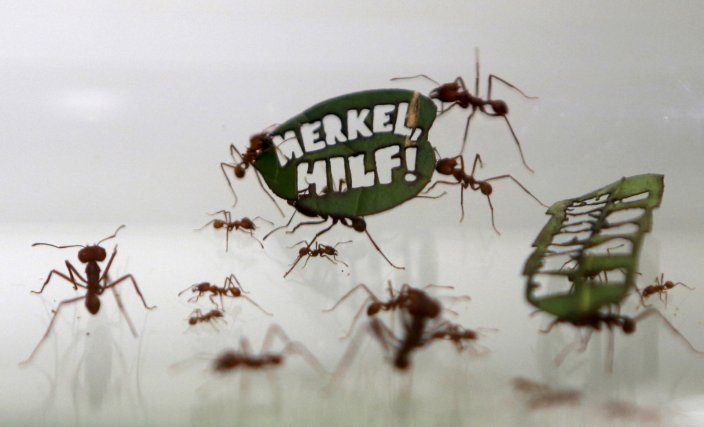
As reported in Newsweek in 2015, employees at the Cologne Zoo laser cut messages into leaf fragments and then had leaf-cutter ants carry the fragments as a plea to Angela Merkel to pressure then-Brazilian president Dilma Rousseff into adopting policies that would be more favorable to Amazon rainforest conservation.
Ant protest. Photo: Ina Fassbender TPX Images of the DA/Reuters
Perhaps such ant protest could first be employed to resist the anti-science (and therefore anti-ant) views of Trump’s nominee to head the EPA, Scott Pruitt.
At 2:00pm Eastern Time today, The Ant Network won the Audience Awards video contest by a mere 34 votes. With an endorsement from The Daily Ant, this stunning victory exemplifies the power of collective action. The Ant Network, led by Miles Maxcer, will be promoting conservation and science outreach through ants, and will receive $1,000 of start-up funds for their contest victory.
I look at an ant and I see myself: a native South African, endowed by nature with a strength much greater than my size so I might cope with the weight of a racism that crushes my spirit
— Miriam Makeba, singer and civil rights activist, in Miriam: My Story (1988)
As we highlighted on Thursday, anybody interested in bringing ants to a wider audience must vote for The Ant Network. Even if you’ve already voted, you can vote once a day until the polls close on Tuesday. When turnout is high, ants win!
The Daily Ant has received an exciting photo from an anonymous source:
This picture was taken in San Jose, California. Furthermore, investigative journalism by The Daily Ant has confirmed that there is, in fact, an AnT Swim School in San Jose. We are happy to have discovered this ant hideout in a major American city!
It may be Friday the 13th, but this article is talking about some lucky ants. Canopy ants, in particular. Ants that forage in trees exhibit a high level of ecological dominance, and ants are usually the most conspicuous organisms running around on tree trunks and branches, especially in tropical forests. This begs the question: Why? Dr. Terry McGlynn and Erica Parra, in a paper published last year, set out to address this question.
Nest of Polyrhachis ants, a dominant arboreal genus. Photo: Alex Wild
The Daily Ant has been a littlepromotional this week, but why stop now? There is another noble antdeavor recently launched by Miles Maxcer: the Ant Network. Vote in support of his video here. Together, we must combat the pervasive vertebrate-first agenda!





 The Daily Ant