If you have never heard of the “Look Around You” British science TV show, you have something else to be thankful for this holiday season:
Myrmecology Dies in Darkness
If you have never heard of the “Look Around You” British science TV show, you have something else to be thankful for this holiday season:
We get it. We really do. Sometimes you feel aimless, like your life is simply going around in circles. Today is like yesterday and the day prior, and the forecast for tomorrow indicates an 89% chance of more of the same. The slog is long.
Today, we’re here to provide some encouragement to you: At least ants know how you feel!
Yesterday, on the pleasingly insect-branded social media site BlueSky, Dr. Jane Waters shared an article – from 1944! – detailing a remarkable behavior of some army ants:
Formally termed an “ant mill”, this rather mesmerizing moving circle forms when nomadic blind army ants, guided by pheromone trails laid by their sisters before them, accidentally purchase tickets on a circular train with direct service to nowhere. As reported by the author of the study, T.C. Schneirla, most of the ants did not make it through the end of the next day. Thus, ant mills are more colorfully described as “death spirals”.
So, feel encouraged, wandering readers, that at least your aimless circle has left you full of life, continuing to step forward – minute by minute, day by day – into the uncertain future. And perhaps your path is not as purposeless as it seems. Ant death spirals inspired philosopher Dr. Briana Toole in her Philosophy Phriday reflection on echo chambers among humans. Who knows what unexpected inspiration your life may bring?

If you are a Camponotus floridanus carpenter ant, you certainly would – at least, according to a recent study published in July of this year in Current Biology. Many thanks to Correspondant Mike Schellman for bringing to our attention this one-minute video that concisely breaks down the results of this surprising study:
Incidentally, this is not the first time that C. floridanus has graced the pages of The Daily Ant. One of the first articles we ever published, “On Ant Spit” (December 20, 2016), also featured a similarly surprising study suggesting that ant saliva serves more functions than previously believed. For a refresher on that spit take, see here.
Okay, this isn’t really a proper Philosophy Phriday contribution, but: Greetings, dear readers! Have you been well? We trust that you have found a way to remain relatively myrmecologically informed in our long absence. We are very pleased to announce that The Daily Ant is back in business. We’ve even launched a Patreon, if you are so inclined to give – check it out!
For those beginning to grow concerned, no, this article’s headline is not an ant bait and switch. So, let’s get to the philosophy. We provide today an excerpt from the 18th-century work Ernst und Falk – Gespräche für Freymäurer (Ernst and Falk – Conversations for Freemasons), by German philosopher Gotthold Ephraim Lessing. In our estimation, it posits an edenic form of societal organization and governance that may especially resonate for many in the U.S. this month:
Ernst — Nothing is easier than to put you back into that condition. Just let yourself down here by me and look!
Faulk — Now what?
E. — The life and the moving to and fro and round about these ant-hills. What industry and yet what order! Every one carries and pulls and shoves and no one hinders another. Just see! They even help one another.
F. — The ants live in society like the bees.
E. — And in a still more wonderful society than that of the bees. For they have no one among them who holds them together and rules them.
F. — Therefore it must be true that order can exist without government.
E. — When each one knows how to rule himself, why not?
F. — Will it ever come to that among men?
E. — Very hardly!
F. — Too bad!
E. — Assuredly!
F. — Get up and let us be going! For they will be crawling all over you, these ants, and just now there occurred to me what I must ask you at this time. I have no idea at all what you think about it…
[See here for the entire discourse. And see here for our new Patreon!]

That’s right – this very day, February 21st, 2023, is the publication date of Ants: A Visual Guide!

If you order today at Princeton University Press, you can even get 30% with the discount “PUP30” (the code works for both the hardcover and ebook version). If that doesn’t sound like a steal, then check out the book description:
Plentiful and familiar, ants make up an estimated one-third of the world’s insect biomass and can be found in virtually every part of the globe, from rain forest canopies to city sidewalks. But their importance is about more than numbers: ants are fundamental species in a range of habitats and their interactions with plants, fungi, and other animals ensure the survival of many fragile and complex ecosystems. This beautifully illustrated book explores the extraordinary diversity of ants and offers insights into their elaborate social systems, investigating the key collective and competitive behaviors that operate within their varied colony structures.
Featuring exceptional close-up photographs and clearly organized thematic chapters, the book covers anatomy, evolution, life cycle, ecology, and other important topics. Each chapter also features profiles of standout genera, chosen for their fascinating characteristics, including Leafcutter Ants, who build nests containing up to 7,000 chambers; Pugnacious Ants whose colonies can destroy populations of crabs within hours; and Honeypot Ants whose worker caste store food in their stomachs for other colony members to consume. Drawing on current research, Ants offers an inviting and accessible introduction to these remarkable insects.
*Includes more than 200 stunning color photographs, plus infographics and diagrams
*Presents full profiles of 42 iconic genera from across the world
*Features clearly structured thematic chapters
So… what are you waiting for? Get your copy today and, when it arrives, place it prominently on your coffee table or bookshelf or nightstand or mantel or face.
Myrmecophile. That’s a word. It’s a big word, too. It’s a word that means “ant lover”, so it is also a word that could apply to you, dear reader. Usually, “myrmecophile” describes any of an impressively large number of species that have close-knit relationships with ants.
We have myrmecophiles on the mind today, because we recently encountered some myrmecophiles in the mind of an ant, courtesy of illustrator and entomologist @czbugsart:
First, it looks like this beauty is not (yet?) up for sale on the artist’s associated Etsy page. But fear not, formicid friends – this similarly heady option is available for the bargain price of $14.50! [Editor’s note: We have not been paid to promote this artist’s work. We just love ants from head to tarsus.]
Now, astute observers will have noticed a claim that myrmecophiles are “often in a toxic relationship” with ants. How could this be?
It turns out that while many myrmecophiles are commensal, such as the inquiline woodlouse Platyarthrus hoffmannseggii that lives in ant nests and noshes on ant poop and mildew, some are more pernicious.
Take the Mountain Alcon Blue butterfly (Phengaris rebeli). Larvae (caterpillars) of this species live inside Myrmica schencki nests as a parasite, receiving food, shelter, and care from their hapless ant hosts. The caterpillars execute this deception through the use of chemicals that mimic their hosts’ cuticular hydrocarbons – chemicals that cover insect exoskeletons that ants use to distinguish friend from foe. But the covert operation doesn’t end there! The sneaky nest parasite can even mimic the sounds that M. schencki queens and workers make, a behavior known as “stridulation”. For more information about stridulation, see this description from the shamelessly plugged Ants: A Visual Guide, coming out tomorrow and already available for pre-order today:
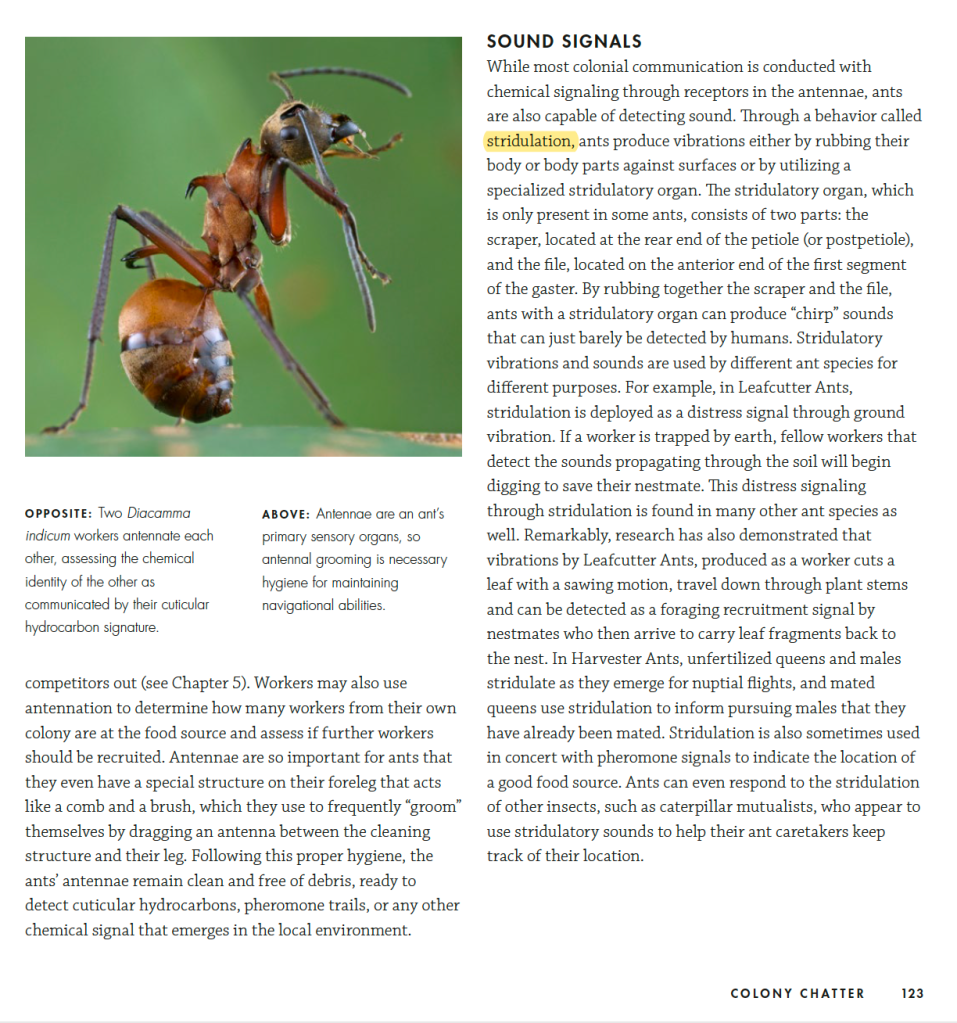
It should be beautiful that ants not only communicate via chemical signals but also through sounds. Yet, instead of appreciating this beauty for what is, Mountain Alcon Blue caterpillars evolved instead to manipulate stridulation for their own benefit, tricking ants into loving them as their own larvae. A toxic relationship indeed!
When we decided to reemerge this week after two long, silent years, it turns out that we chose an especially auspicious season. Evidence of our fortune first presented itself via this tweet from the most influential cinematic account on Twitter:
Is it a coincidence that this tweet was tweeted on Monday, the very day we resumed posting? We defer to the considered judgement of our dedicated readers.
Because ant hips petioles don’t lie, the very next day, that which was promised was made manifest. Behold, the trailer for the THIRD installment of the Ant-Man series:
Now, like you, we are a little disappointed at the perplexing absence of ants (AKA absants) in the trailer. You can’t spell “Quantumania” without spelling “ant”. Please note, however, that the filmmakers did wisely release an alternative version tailor-made for ants. So we can’t complain too much.
The only question now is: Where will you be on February 17, 2023? Emoji reacts only.
There is a moment in the life of every media outlet dedicated to providing premier ant content for general consumption when it becomes inescapably clear that silence is no longer an option. Formicid friends, readers, and inquilines, we at The Daily Ant have arrived at such a moment. We have been silent for two full years and in so doing have inadvertently allowed to fester that which by any other name would smell as sweaty: myrmecophobia. Behold, if you must, this horrific headline peddled by the bipedal Cable News Network: “A face only a mother could love: Terrifying photo shows what an ant looks like close-up”.
Terrifying? The only terror here is the vertebrate media corporation promulgating an immoral and bizarre ideology whereby a wise ant queen’s love of this mesmerizing and gorgeous visage indicates anything other than that such a face inspires adoration:

And yes, if you can believe it, there is in fact more. The CNN article (read: hit piece) opens with a reference to a Game of Thrones spinoff show:
“No, this photo doesn’t portray one of the new creatures on HBO’s ‘House of the Dragon,’ or an outtake from a horror movie. It’s an award-winning close-up photo of… an ant.”
Ignorance may be bliss, but CNN’s happiness is worth pittance compared to the ectothermic, chitinous truth. Maybe they should try reading even a single chapter of any book, like Chapter 54 of A Storm of Swords, the third installment of A Song of Ice and Fire:
“An ant who hears the words of a king may not comprehend what he is saying, and all men are ants before the fiery face of god.”
The sooner every media writer goes to the ant and observes the commonalities between humans and ants, the better. As a useful starting point, here are two beautiful ant species named after Game of Thrones dragons, Pheidole viserion and Pheidole drogon:
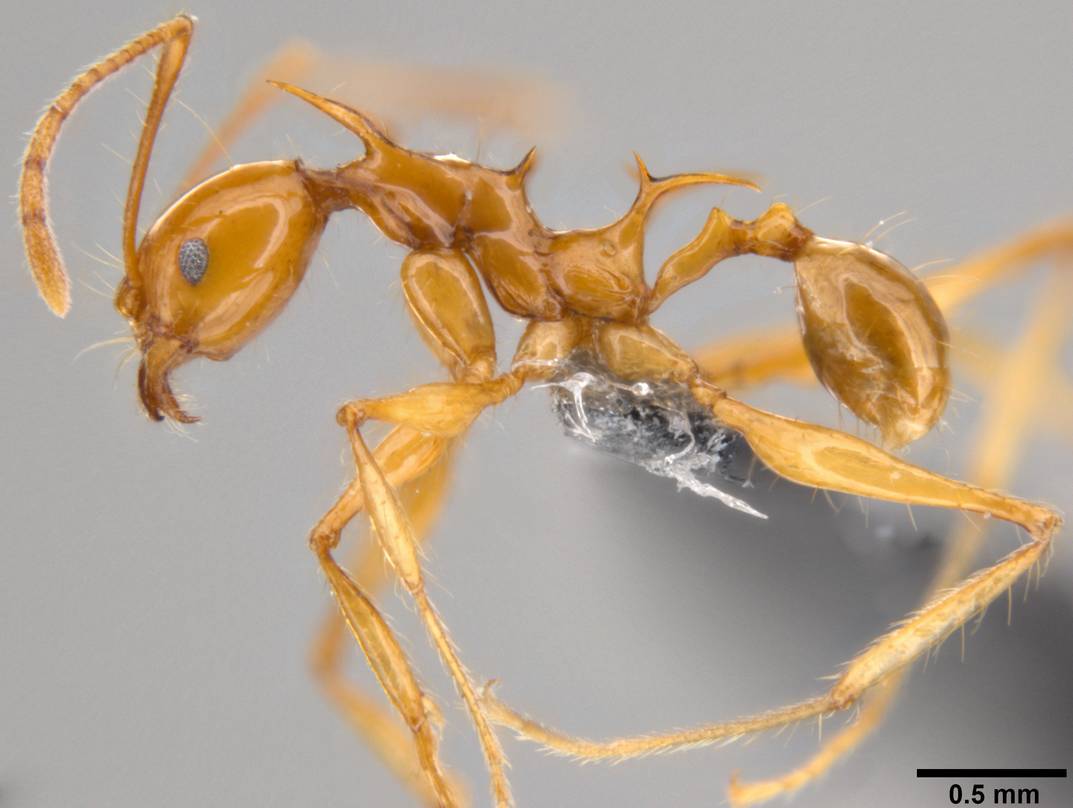
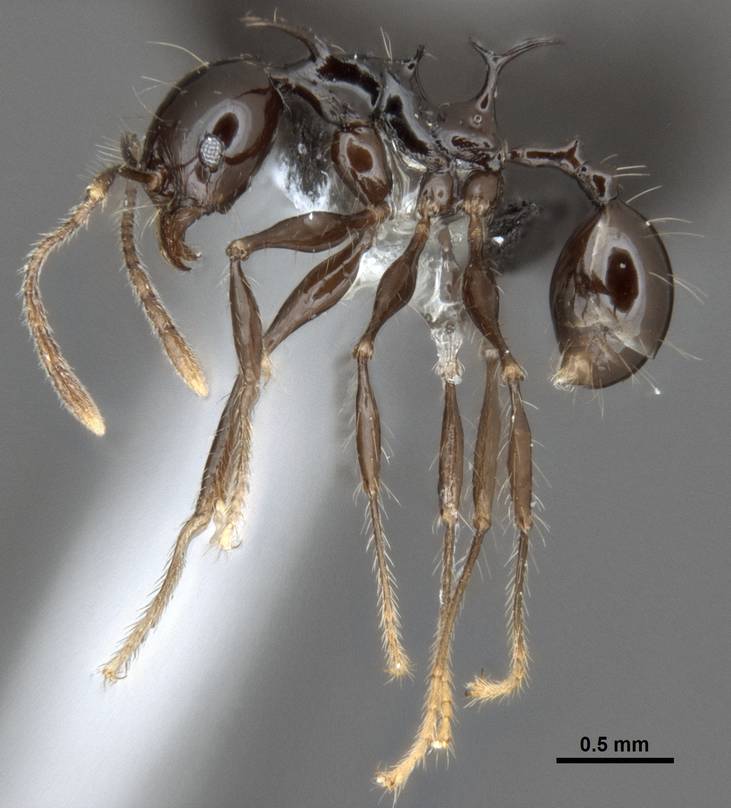
It is delightful to share the Earth with so many faces to love! Some may try to push a narrative that would have us forget this joy. We regret to inform those malfeasant actors that The Daily Ant has triumphantly returned to speak for the beloved creatures underfoot.
Most of our formicid-loving Jewish readers will know that we are amidst the Jewish holiday of Sukkot (Feast of Tabernacles). Tonight will be the sixth night of the seven-day holiday.
The intermediate days between the first and last days of Sukkot (as well as Passover) are called Chol HaMoed. This is important, because it turns out that the Talmud is concerned with myrmecological endeavors during Chol HaMoed! As explained in this article, Moed Katan 6b (here) not only states that you are allowed to “destroy ant holes” during this period, but even explains in surprising detail how to go about wreaking such distraction:
… and one may destroy ant holes so that the ants will cause no damage. How does one destroy ant holes? Rabban Shimon ben Gamliel says: One brings soil from this ant hole and places it in that ant hole, and since the ants from the two nests are not familiar with each other, they strangle each other.
But the advice doesn’t end there! Observe:
Rav Yeimar bar Shelamya said in the name of Abaye: And this advice works only in certain circumstances: When the ant holes are located on two opposite sides of a river, when there is no bridge connecting the two sides, when there is not even a plank bridge over the water, and when there is not even a rope stretched taut across the river. If there is any connection whatsoever between the two sides of the river, the ants from the two nests are likely to recognize each other and not fight.
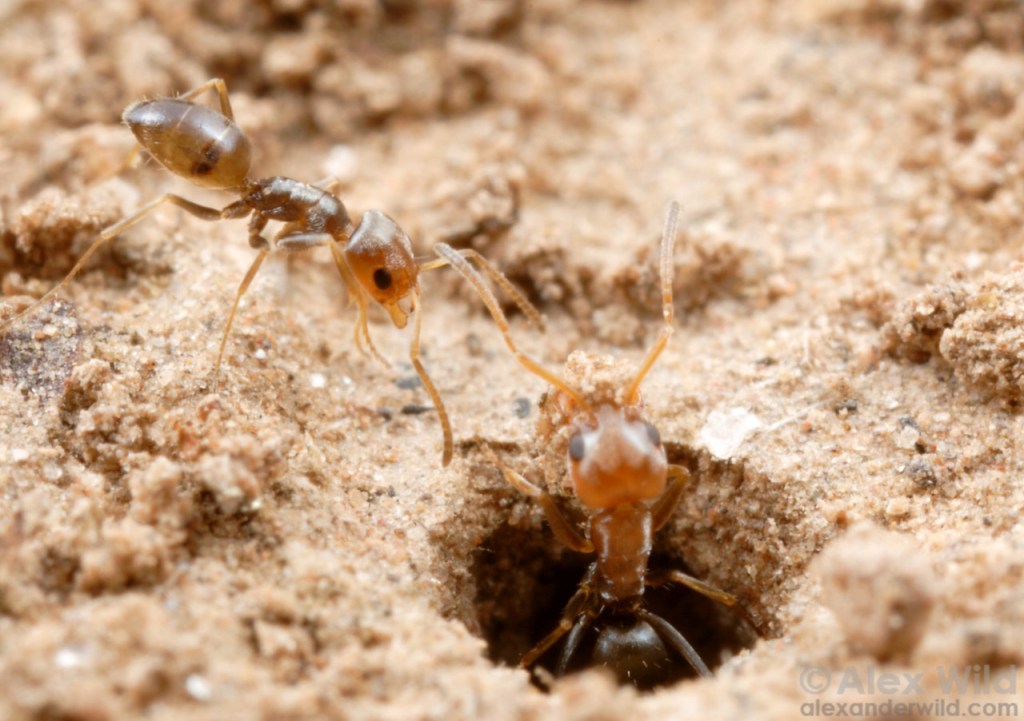
It is perhaps unsettling that ants appear here in the Talmud only to better advise humans on how they might better destroy the homes of our social insect friends. However, the expressed knowledge of ant social behavior is nevertheless impressive, so one cannot be too upset at this manner of inclusion in the religious text.
Earlier this year, BBC Earth put together a 20-minute video titled “Best of Ants”, a collection of their “Top 5 Ant Moments”. Enjoy!
On Sunday, our editor-in-chief was interviewed by a new ant-keeper podcast with the delightful name “FormiCast“! Although the focus of the podcast is generally ant-keeping, the interview focused more on various ant facts, including a question and antswer period. The interview begins at about minute 6:00 in the video embedded below. Enjoy! [UPDATE: It turns out that the below video recording of the interview was only temporary – click here for the audio podcast version.]
In addition to YouTube, you can also find FormiCast on Instagram, Facebook, Twitter, and Anchor.
Ants are so beautiful that even the true bugs wanna be them. Check out this ant mimic larvae in the order Hemiptera (the “true bugs”), shared on Twitter by PhD student Naoto Idogawa (井戸川直人) of Kyoto University. Remember, though it may be hard to believe, this is *not* an ant!
One of the clearest signs that ants have achieved grand success in both an ecological and evolutionary sense is the high number and taxonomic range of organisms that have evolved, over millions of years, to closely mimic the behavior and appearance of our favorite Hymenopterans. Ant mimicry – known as myrmecomorphy – is currently known among crickets, spiders, true bugs (as we have seen), sticks insects, thrips, mantises, flies, beetles, and even plants!
Myrmecomorphy is the sincerest form of imitation and is thus flattering indeed.
 The Daily Ant