This is a turtle:
Many people around the world believe that turtles are boring.
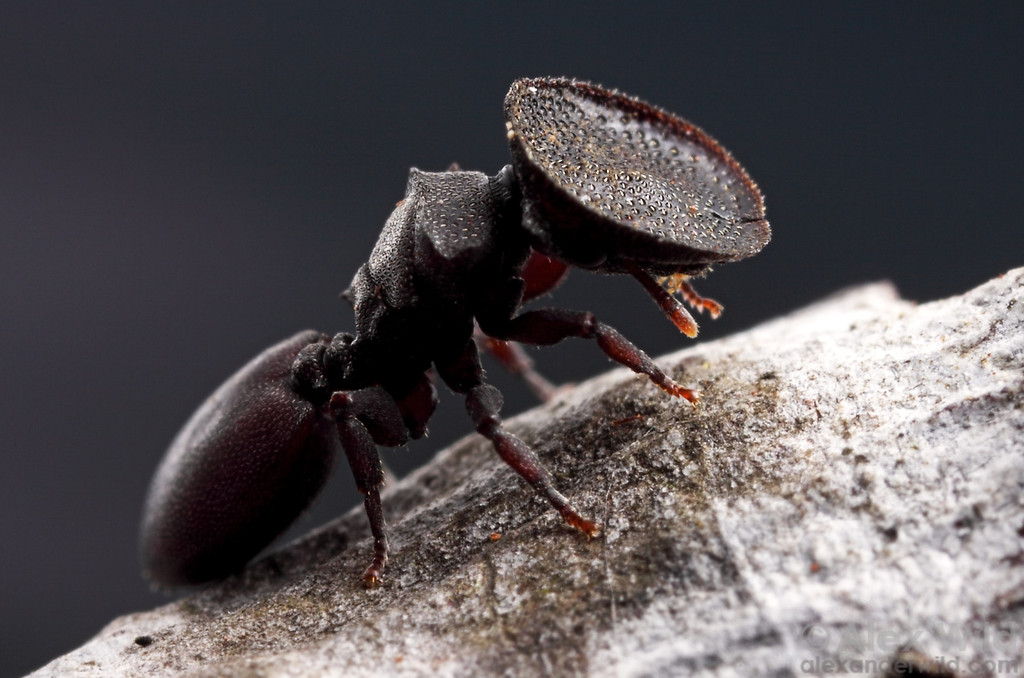
This is a turtle ant:

Many people around the world believe that turtle ants are fascinating.
Reportedly, one of the turtle ant characteristics that people love most is how they use their heads to block their nest entrances. But these turtle ants may also provide insights into the evolution of worker castes in ants, as shown recently by Dr. Robert Planqué and colleagues in a new study published in the Journal of Evolutionary Biology.
In the study, the authors focus on the concept of “disruptive selection”. Disruptive selection is a type of natural selection that favors extreme phenotypes and/or selects against intermediate or mean phenotypes. This process can be promoted by intraspecific competition – it may be advantageous to have traits that are different from a competitor in order to utilize some resource without the cost of competing for that resource. The expected outcome of disruptive selection is the evolution of two separate phenotypes within a population, which may then lead to the evolution of new species.
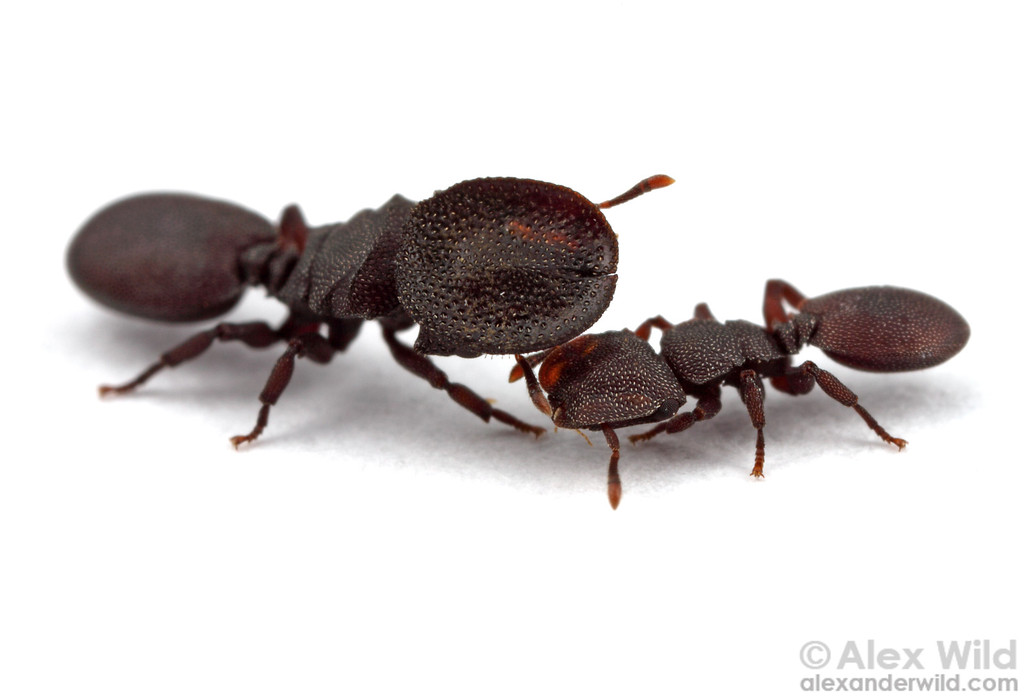
Using a mathematical model informed by extensive knowledge of turtle ant biology, Dr. Planqué and colleagues considered how disruptive selection might have given rise to two different worker castes in the turtle ants. The results of their simulations using their model suggest that a soldier caste may in fact arise from disruptive selection driven by competitive interactions. In particular, in their model, the inclusion of coupled ecological specialization and defensive trait parameters produced simulation outcomes that include the evolution of a soldier caste. In other words, when the presence of a new caste with defensive traits promotes the use of a narrower range of resources, a soldier caste evolves. This is surprising, because the prevailing view is that worker castes arose as way to access a wider range of resources.
Beyond this core finding, one of the especially enjoyable aspects of this study was the use of an explicit model derived from known biological dynamics in turtle ants. Such a model framework allows for the proposed hypotheses to be tested in a more rigorous, quantitative way, and the assumptions underlying the model can be adjusted to test alternative hypotheses. Even if the disruptive selection explanation for caste origins is challenged in the future, this work by Planqué and colleagues highlights the utility of explicit, biologically-informed models for addressing evolutionary hypotheses in ants.
UPDATE: As noted by Dr. Scott Powell in the comments, the authors present disruptive selection as just one possible explanation for caste evolution that has not previously been considered.


 The Daily Ant
Leave a comment