The Daily Ant hosts a weekly series, Philosophy Phridays, in which real philosophers share their thoughts at the intersection of ants and philosophy. This is the thirty-fifth contribution in the series, submitted by Dr. Megan Wallace.
Certain reflective ants spend their lives asking deep, meaningful questions such as: Do ants have free will? Do ants have souls? Does ‘good’ mean the greatest happiness for the greatest number of ants? Is it morally permissible to use other ants as a means to an end? Is there an ant such that no ant is more fantastic than it? And so on.
The Daily Ant hosts a weekly series, Philosophy Phridays, in which real philosophers share their thoughts at the intersection of ants and philosophy. This is the thirty-fourth contribution in the series, submitted by Dr. Kenny Easwaran.
Mutualistic Anteractions
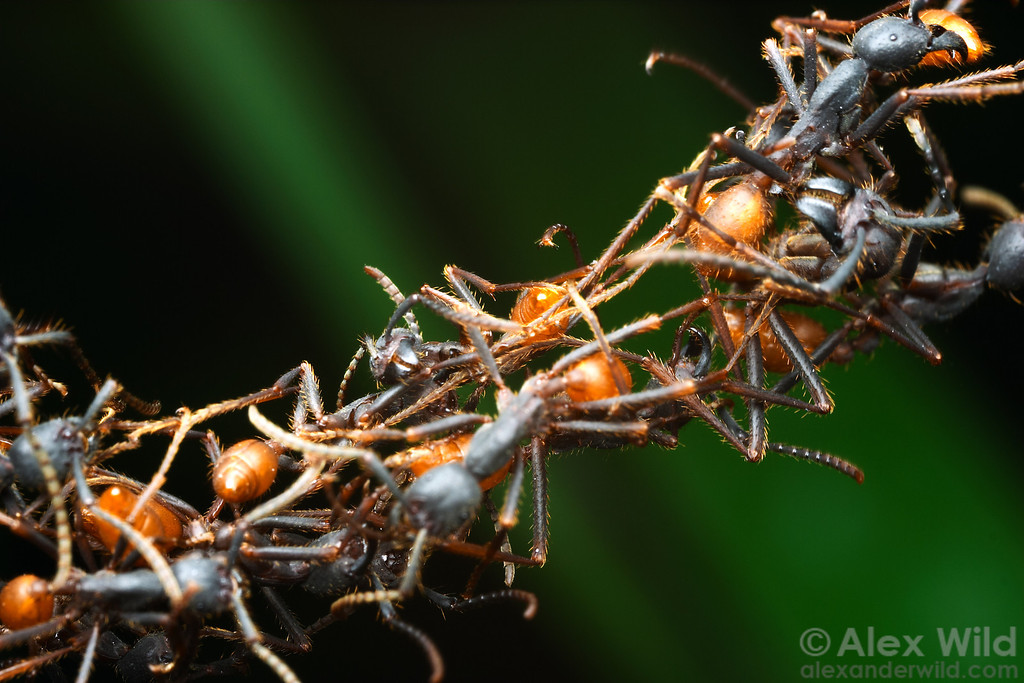
Individual ants do amazing things. They lift huge objects, bring food to the nest, bite gigantic creatures, sacrifice themselves for others, and lay eggs to start a colony. Ant colonies also do amazing things. They find food at a distance, drive off mammals and poison trees, plan when and where to make new colonies. The behavior of the colony is constituted by the behaviors of the individuals, but are there also cases in which the behavior of an individual is constituted by the behavior of the colony?
Ants doing an amazing thing – building a bridge. Photo: Alex Wild
The Daily Ant hosts a weekly series, Philosophy Phridays, in which real philosophers share their thoughts at the intersection of ants and philosophy. This is the thirty-third contribution in the series, submitted by Dr. Rivka Weinberg.
In late Spetember, Dr. Rivka Weinberg sat down with The Daily Ant to discuss the point of life, reproductive ethics, and ants! Given that we are posting this on a Monday, you may also call this “Meaning Monday: Video Interview with Rivka Weinberg”. Enjoy!
NOTE: The Daily Ant apologizes to Dr. Weinberg and our readers for the egregious levels of interrupting by our editor-in-chief. He promises to do better in the future!
UPDATE (October 10th): Dr. Weinberg graciously responds to our note, saying “she did at least her fair share of interrupting too and enjoys conversations where the ideas can tumble out all over each other, unimpeded by burdensome standards of politeness.”
Dr. Rivka Weinberg is an associate professor of philosophy at Scripps College. Her work focuses on moral obligation, procreative ethics, and the metaphysics of birth and death. Weinberg’s recent book, The Risk of a Lifetime: How, When, and Why Procreation Might be Permissible, presents intriguing moral challenges to the act of procreation, arguing in favor of expanding our view of procreation beyond welfare risks to include other serious moral risks. Weinberg is currently developing ideas on the pointlessness of life. Make sure to check out her 2015 New York Times opinion piece, “Why Life is Absurd”, here.
Early Saturday evening, an anonymous source revealed to The Daily Ant that the cartoonist John Atkinson has found himself antspired – or has he? The source implored The Daily Ant to discuss this image in Wrong Hands, and we extend the command to you, our dear readers.
The Daily Ant hosts a weekly series, Philosophy Phridays, in which real philosophers share their thoughts at the intersection of ants and philosophy. This is the thirty-second contribution in the series, submitted by Dr. Kieran Setiya.
Ant-I-Intellectualism
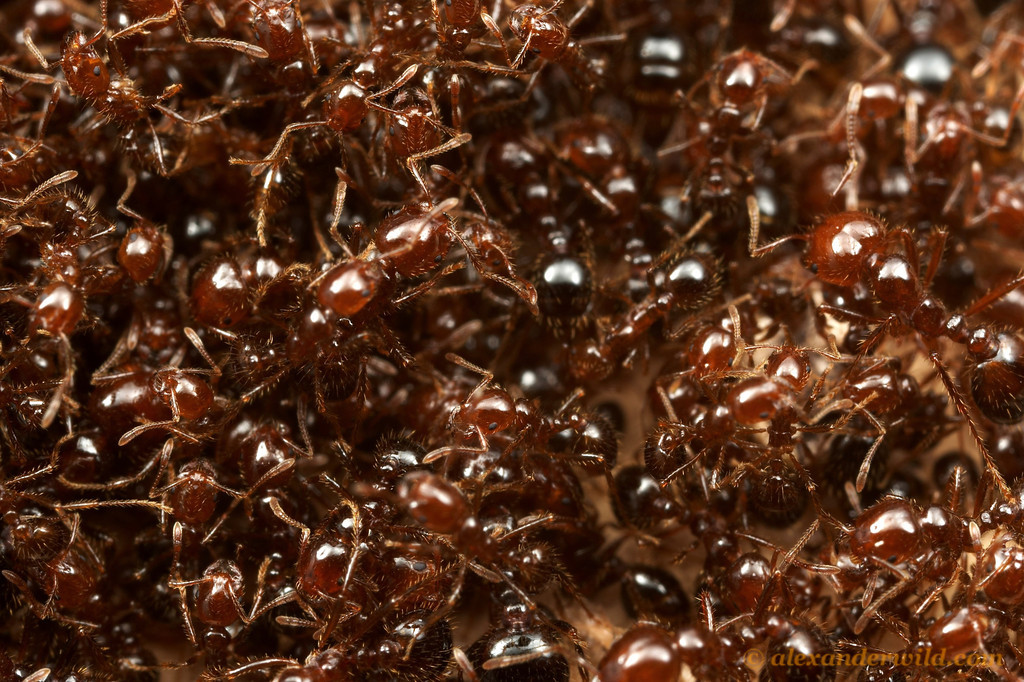
We often get ants in our kitchen: relentless black ones scurrying from place to place with an air of purposive intelligence. Betraying no hint of indecision, they seem to know exactly what they are doing.
This is an ant, looking all relentless and purposeful. Photo: Alex Wild
The Daily Ant is excited to report that Pulitzer-prize winning journalist and prominent leftist critic Glenn Greenwald visited the Field Museum’s AntLab midday on Tuesday, participating in a special tour arranged by our very own editor-in-chief, Benjamin Blanchard.
Although in Chi-Town for a speaking and book signing event at the University of Chicago, Greenwald, who is also a co-founder and editor of the media outlet The Intercept, heroically arranged his time in order to fit in the hour-long tour at the Museum. Meeting Blanchard and his advisor, Dr. Corrie Moreau, at the steps of the Museum’s expansive South Entrance, the journalist confessed to Moreau that he calls Blanchard “the nation’s most enthusiastic ant fan”.
The Daily Ant is thrilled to announce that we will be conducting a video interview with none other than Dr. Rivka Weinberg (Scripps College) for our popular Philosophy Phridays series! Weinberg (no relation to Justin Weinberg) has agreed to take questions from our many readers, even including “unfair questions”. So, please let us know any question you have by writing in the Comments section of this post or by emailing your query directly to us! The ant-ier the better!
Weinberg’s work focuses on procreative ethics, moral obligation, and the metaphysics of birth and death. Her recent book, The Risk of a Lifetime: How, When, and Why Procreation Might be Permissible, presents intriguing moral challenges to the act of procreation, arguing in favor of expanding our view of procreation beyond welfare risks to include serious moral risks. How much of a moral burden do procreative parents carry? Are gametes hazardous material? What do ants have to do with this? These are just some of our questions, but we want to hear yours, too!
The Daily Ant hosts a weekly series, Philosophy Phridays, in which real philosophers share their thoughts at the intersection of ants and philosophy. This is the thirty-first contribution in the series, submitted by Dr. Anne Pollok.
Antropology, or, what we can learn from ants and a fiction called Diotima
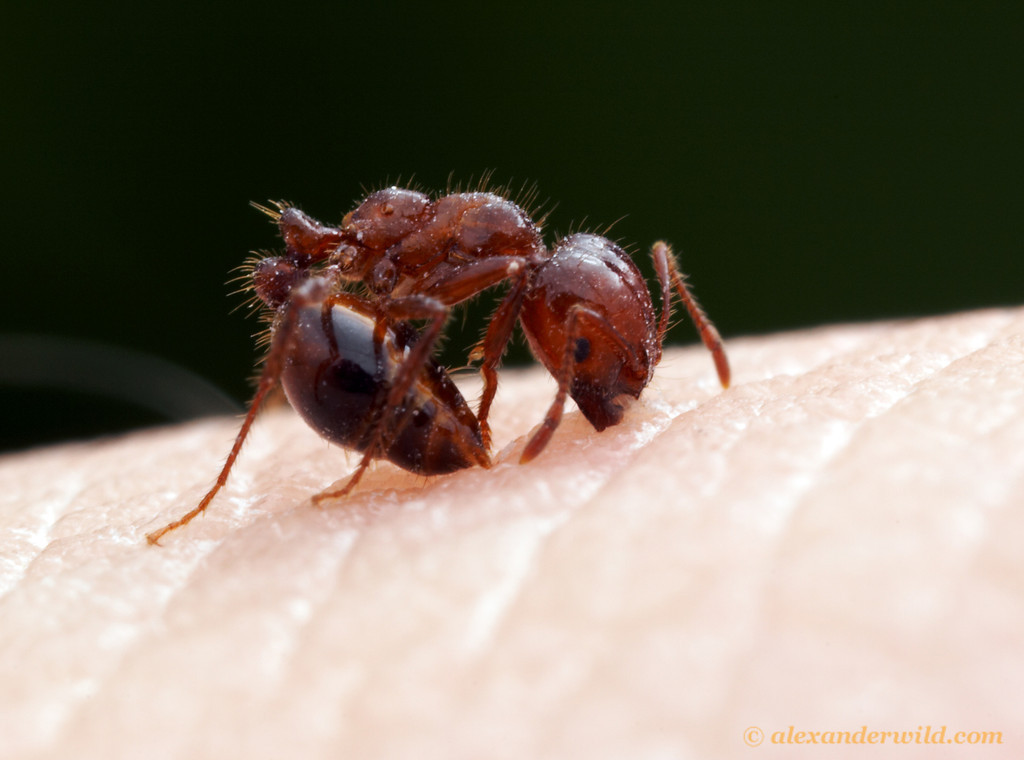
I do not know much about ants. But, come to think of it, I doubt that any of us do – if we take “knowing” in a richer sense. As Wittgenstein holds, even if a tiger could speak our language, we still wouldn’t be able to understand him and his language games. This holds even more true for ants. Whom could and should we even address – who is playing the language game (or, better and more loosely, behaving game)? Even the term ‘individual’ as an addressee of a conversation (and whom we could even attempt to understand) becomes questionable here – and that is even before we start swearing because of those stings!
We may not know this ant, but we feel her sting. Photo: Alex Wild
Still, I do think that we can learn something from ants, in particular from our way of understanding them – especially as it relates to human culture as a means of immortality.
The Daily Ant hosts a weekly series, Philosophy Phridays, in which real philosophers share their thoughts at the intersection of ants and philosophy. This is the thirtieth contribution in the series, submitted by Dr. Kevin Timpe.
The Fecundity of Ants and the Goodness of Existing
“Kevin! Get in here!” comes my wife’s voice from the kitchen, brimming with an emotion somewhere between irritation and exasperation.
We’d just moved our family of five over 1,500 miles across the country, replete with all the difficulties that such a transition involved, and were trying to settle into our new house in time for the school year to begin.
“What’s the problem?” I ask, hoping it’s something falling within my fairly narrow skill set.
“We have ants in our pantry. Ants. And lots of them!”
Words like ‘lots’ are, of course, context sensitive. Three or four dozen ants crawling around our pantry and into our recycling bins is certainly more than I want in my house. But looked at in other ways, that’s not a lot.
It turns out that a component of the chemicals released in a fire ant sting also may alleviate some symptoms of an auto-immune disease called psoriasis. And Kim Kardashian has psoriasis. Thus, fire ants could be used to help Kim Kardashian.
But our story does not end with this New York Daily News article. Investigative reporting by The Daily Ant has revealed that the Kardashian family is remarkably antlightened. There are at least two other occasions of Kardashians dabbling in the world of Formicidae. Consider this scientific inquiry by both Kourtney and Khloé Kardashian:
People say it takes a village to raise a child. People ask me how my daughter is doing. She’s only doing good if your daughter’s doing good. We’re all one family. We have the ability to approach our race like ants, or we have the ability to approach our race like crabs.
Thus, The Daily Ant is surprised to report that Keeping Up with the Kardashians by association, is one of the most ant-friendly shows currently on television.
UPDATE (09/13/2017): Public Relations Consultant Natalia Piland suggests that The Daily Ant ought to answer Kourtney’s and Khloé’s noble inquiry. The answer is: Yes, basically. In ants, as in other insects, it’s called an aedeagus.
The Daily Ant hosts a weekly series, Philosophy Phridays, in which real philosophers share their thoughts at the intersection of ants and philosophy. This is the twenty-ninth contribution in the series, submitted by Dr. Samantha Noll. We apologize for the delay this week, but it was worth the wait!
Ant Philosophies of Farming
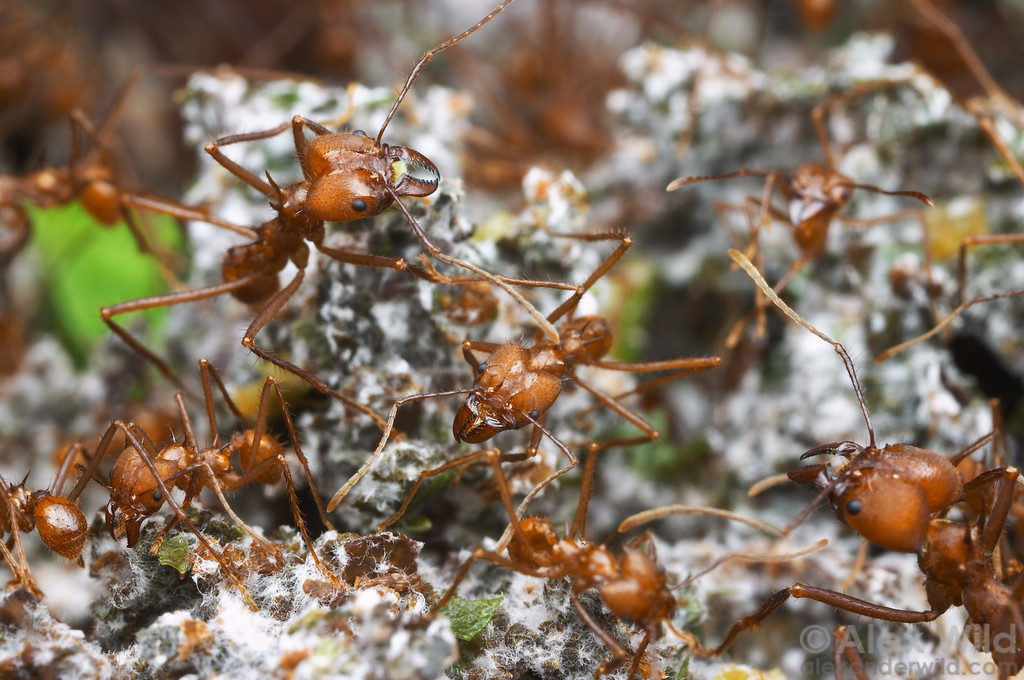
Like humans, one of the reasons why ants are successful as a species is that they have the ability to eat a wide variety of things, from plant matter to other insects and even dead animals. Different species of ants prefer different types of food, but the cornucopia of options flows over for these little omnivores. In addition, ants have also learned how to cultivate their favorite foods (Klein, 2017). In fact, ants developed farming techniques millions of years before humans and can be accredited with the discovery of many of the practices that we currently employ. Today as many as 250 distinct species actively cultivate and maintain fungus “farms” for food (Klein, 2017). In tropical areas, grassland, and deserts, colonies grow their crops in underground rooms, where they weed, water, and use chemicals and antibiotics to remove bacterial threats and thus to increase crop-yields (Branstetter et al., 2017). They even employ monocropping techniques and were the first to domesticate a type of fungus for their food usage. In some instances, ants and the fungi developed a co-dependent relationship, each depending on the other for survival. When viewed from this perspective, one could argue that ants were the first agrarians, creating and controlling novel ecosystems to ensure food security & ecological sustainability for ant-kind.
Ants farmed millions of years before new humanoid agro-fads. Photo: Alex Wild



 The Daily Ant