• I just completed a 4-minute lightning talk on my recent work with Dr. Corrie Moreau on defensive trait evolution in ants, in the final session of talks at the SSB 2017 Standalone Meeting in Baton Rouge! For more information, see the published paper in Evolution and/or the brief blurb I wrote about it on U. Chicago’s ScienceLife blog.

    — The Daily Ant editor-in-chief, Benjamin Blanchard

  • With our editor-in-chief in Louisiana, our thoughts have naturally turned to Louisiana and ants. We therefore stumbled upon this article reviewing several Louisianan politicians. This passage stood out:

    Best in Show: Senate President John Alario.  He’s the most gifted person in Louisiana politics. I quote here the anonymous individual who nominated the unsinkable Republican leader of the state Senate: “Watching him with his Senate colleagues — and often, his House counterparts — is comparable to observing an ant communicate with his pals in the pile. He detects solutions (food) to problems in [obscure] places, recruiting his colleagues to follow him (leaving that chemical trail thing like those little biters do). Once there, he fights like hell to carry that golden nugget of solution to the Queen Ant, which — if you follow this metaphor — can be considered Louisiana. His nickname, ‘Yahweh,’ pretty much sums up his colleagues’ affection for him.”

    It goes without saying that this ant metaphor, employed to push a politicized agenda, fails to rise above the usual stereotypes perpetuated by the vertebrate ruling class. The “anonymous individual” fails to recognize, in saying “his pals in the pile”, that the worker ants referred to are all female. After the offensive reference to “little biters”, this individual then promotes the usual image of ants as hyper-hierarchical, apparently unaware that many worker ants deliver food directly to the larvae or other worker ants, not just to the queen. And finally, perhaps most errant of all, the anonymous person suggests that the adulatory affection for Senate President Alario by his colleagues – to the level of calling him “Yahweh” (!) – is comparable to the ways of the ant. Nothing could be further from the truth. Such individualistic adoration is anathema in an ant colony, as the colony works together in a highly organized and functioning community.

    Ants understand that personal ambition and fame should not supersede the concerns of their community. And, speaking of YHWH, this is what the Tanakh has to say about us:

    Go to the ant, you sluggard;
        consider its ways and be wise!
    It has no commander,
        no overseer or ruler,
    yet it stores its provisions in summer
        and gathers its food at harvest.
  • The Daily Ant would like to report that our Editor-in-Chief is in transit to attend the SSB 2017 Standalone Meeting in Baton Rouge. He will be giving a lightning talk on defensive trait trade-offs and diversification in ants. Also in attendance will be Dr. April Wright, who will be giving a talk on using the fossilized birth-death method for phylogenetic dating in ants. Exciting!

  • Using Queen Head Coloration to Estimate Habitat Disturbance

    A recent study by Oksana Skaldina and Jouni Sorvari looked at head coloration in ants as a possible metric for the level of disturbance in European boreal coniferous forests. The researchers, both from the University of Eastern Finland, compared the level of melanization in the heads of queens in the wood ant species Formica aquilonia in native versus disturbed forest habitats. Notably, F. aquilonia is listed as “Near Threatened” by the IUCN.

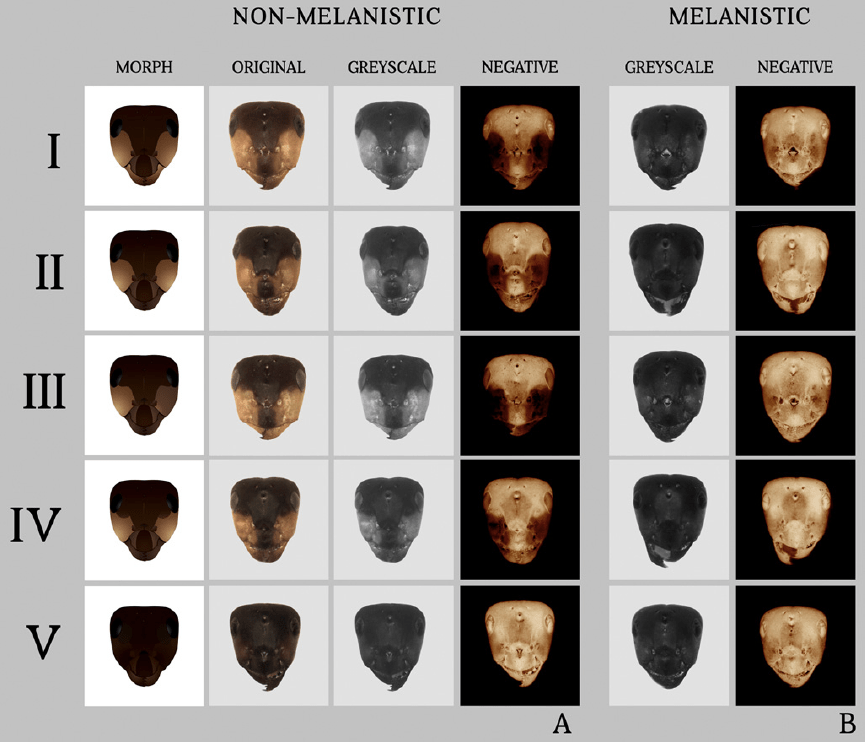
    In order to quantitatively compare melanization, Skaldina and Sorvari used Adobe Photoshop and ImageJ. Using these programs, they converted head shots to greyscale, and then into negative photos, which better emphasized differences between the samples (and also made the ant heads look pretty cool!).

    screen-shot-2017-01-05-at-12-31-20-pm
    Figure 2 from Skaldina and Sorvari (2017)

    In the end, the researchers found that the morph with the highest degree of melanization, Morph V, was only found in the disturbed habitats. Although less melanized morphs were also found in disturbed habitats, the results of this study suggest that the fairly easily identifiable trait of color may be useful in assessing the level of disturbance in various habitats.

    Color, as a whole, is not often considered with ants, due to a decent amount of color variability within even single ant colonies in many species. But, as this study suggests, color may still provide some useful information that may help us track environmental disturbance, as well as address other interesting ecological and evolutionary questions.

  • Theaters across the U.S. have made good money from Rogue One: A Star Wars Story. Audiences have flocked to see this film about a fictional ragtag team setting out to save the Rebellion. Yet few know about a moving story shared by a rebel not from a galaxy far, far away, but from Xinjiang, China. Rebiya Kadeer, a Uyghur civil rights activist, shared a story about a bird and a little ant at the beginning of her 2009 book, Dragon Fighter: One Woman’s Epic Struggle for Peace with ChinaThis story has been reproduced below. Enjoy!

    (more…)

  • The A.N.T.S. of Wyoming

    Nontraditional college students – for example, those that begin college at a later age compared to many recent high school graduates – may sometimes feel isolated from their general college community. But at Western Wyoming Community College, nontraditional students banded together to form a club. This club, of course, is called the Association for Non-Traditional Students (A.N.T.S.).

    (more…)

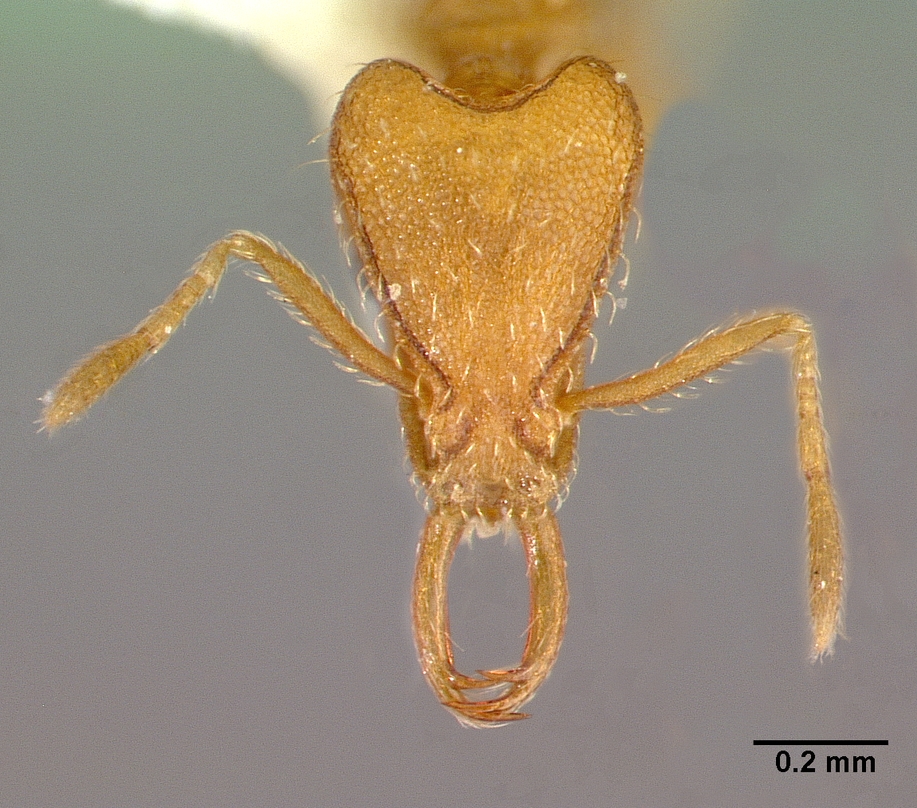
  • Trap-jaw ants are awesome – few dispute this fact. Yet despite the remarkable nature of the trap-jaw mandibular structure, quantitative assessments of predator-prey interactions and ecology in this group are fairly rare. This is particularly surprising given that trap-jaw ants are an ideal system for understanding how morphological structures vary within species across a wide geographic range. Recognizing this utility, Dr. Kyohsuke Ohkawara and colleagues recently conducted an interesting study in this group, which was published last month. They investigated the impact of variations in prey size on the shape of mandibles in Japanese trap-jaw ants.

    s_lewisi
    Head view of the trap-jaw ant Strumigenys lewisi. Photo: AntWeb

    (more…)

  • How readily our thoughts swarm upon a new object, lifting it a little way, as ants carry a blade of straw so feverishly, and then leave it.

    — Virginia Woolf, The Mark on the Wall (1917)

    vwoolfe

  • At 2:15pm Eastern Time today, Jezebel posted its annual list of favorite posts of the year. To our surprise, a question asked by our very own editor-in-chief was chosen as one of the few items on the list!

    (more…)

  • There is a band called Ants in the Kitchen.

    antsinkitchen

    Ants in the Kitchen are playing at Wildhorse Casino in Pendleton, Oregon for New Year’s Eve.

    We at The Daily Ant wish everyone a responsible (i.e. antsy) New Year’s Eve celebration!