One of the more stunning biological discoveries to date is that organisms like ants are not merely individual organisms, but also hosts to trillions of bacteria. Some biologists have increasingly focused on this “microbiome”, and naturally work in ants is no exception. A few months ago, a group of ant researchers discovered yet another cool thing about ants and their microbiome!
The Daily Ant
Myrmecology Dies in Darkness
-
The Daily Ant maintains “Formicid Form”, a Sunday ant poetry series. When possible, our Verse Correspondant, Natalia Piland, provides a short commentary at the end of each poem. Enjoy!
The Ant (1902-1971)
By Ogden Nash
The ant has made herself illustrious
By constant industry industrious
So what?
Would you be calm and placid
If you were full of formic acid? -
The Daily Ant hosts a weekly series, Philosophy Phridays, in which real philosophers share their thoughts at the intersection of ants and philosophy. This is the fifty-fourth contribution in the series, submitted by Dr. Daniel Singer.
To Understand Ant Communication, We Can’t Forget What Ants Forget
It is well-known (to any reader of this blog, anyway) that ant communication is very complex and not entirely well-understood. Among myrmecologists, there is disagreement about how information is transferred (most think that pheromones play a key role, but some think there may be other mechanisms at play, including sound), what kind of information is transferred, and whether we should explain ant communication in terms of the communication behaviors of individuals or groups.
-
If you’re anything like us, you’ve been spending a lot of time lately wondering about ant species coexistence. How can there possibly be 13,384 species of ants, when so many species have overlapping niches in space, food resources, and other traits? Shouldn’t the most competitive ant species ultimately drive all the others to extinction?
-
Well hello there! We’ve been on a bit of a hiatus, haven’t we? We do apologize for any pain our absence may have caused to our most dedicated readers, and are happy to report that premier ant content once again flows from the pages of The Daily Ant.
-
Here at The Daily Ant, we’ve consistently found that the brilliant Samantha Bee lives up to her namesake. Bee’s wit frequently skewers the worst of the vertebrate right. Thus, we were truly shocked when Fraternal Correspondant Joshua Blanchard shared with us a tragic comment Bee made in a recent show, laying bare that even Bee is anti-ant:
-
The Daily Ant hosts a weekly series, Philosophy Phridays, in which real philosophers share their thoughts at the intersection of ants and philosophy. This is the fifty-third contribution in the series, submitted by Gretchen Ellefson.
What Do (Ant) Emojis Mean?
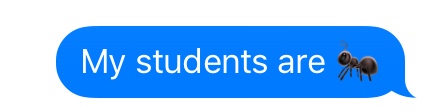
According to the reputable website emojis.wiki, the ant emoji,
 , is “a synonym for ‘hardworking.’” This came as a surprise to me; I, a proficient emoji user, have never used the ant emoji in that way (despite that I have used an ant emoji), nor have I ever interpreted an ant emoji sent to me in that way. More importantly, however, I’m not quite sure what it means for an emoji to be synonymous with an English word. Generally, we take two words to be synonymous when they have the same meaning. But what it takes for an emoji to mean something is rather different than what it takes for an ordinary word to mean something. Philosophers of language sometimes talk about sentences as having the same meaning when they have the same “truth conditions”—when the conditions under which they would count as true are the same—and bits of sentences as having the same meaning when they play the same role in contributing to the truth conditions of a sentence. So “My students are hardworking,” is true whenever my students have the property of being hardworking. What about, “My students are ”? Does this have the same truth conditions? Probably not. On the one hand, the association between ants and hardworkingness is sufficiently commonly accepted that I could certainly use “My students are ” to mean that they are hardworking. But it is just as likely that in saying, “My students are ,” I could communicate something else: that my students are very small, or that they can carry many times their body weight, etc. So what does “My students are ” mean?
-
The Daily Ant hosts a weekly series, Philosophy Phridays, in which real philosophers share their thoughts at the intersection of ants and philosophy. This is the fifty-second contribution in the series, submitted by Madeline Eller.
The Formicid Mystique: Embodied Social Norms and Common Sense
One of the reasons that I am happy to be a philosopher rather than a scientist is that I have never had to glue tiny stilts onto an ant’s legs. Some poor grad student presumably had this task when collecting data for Wittlinger et. al.’s “The Ant Odometer: Stepping on Stilts and Stumps”. In the 2006 article, Wittlinger et. al. argue that they have solved the long-standing mystery of how ants navigate to and from their nest without retracing their steps. Indeed, the Saharan desert ants, Cataglyphis fortis, can explore the surrounding landscape in a roundabout, Magellanic adventure, and then find their way back to the mound using a direct route rather than retracing their steps. How? They use what Wittlinger et. al. call “a path integrator”, which employs directional data from the ant’s “celestial compass” and travel distance as gauged by an idiothetic pedometer (ibid., p. 1965). The pedometer is crucial for the ants to know how far they are from the nest; when stilts were attached to their legs, making their legs longer, the ants overshot the location of the nest, and when the ant’s legs were shortened, they undershot the distance.
-
The Daily Ant hosts a weekly series, Philosophy Phridays, in which real philosophers share their thoughts at the intersection of ants and philosophy. This is the fifty-first contribution in the series, submitted by Dr. Helena de Bres, with illustrations by Dr. Julia de Bres.
The Ants Who Prefer Not To
If there’s one thing we think we know about ants, it’s that they work hard. Ants are always dashing around, engaged in some urgent task—and they’re very efficient about it, too. Ant colonies involve a complex division of labor, in which each ant is assigned a specific role. Some are foragers, some gardeners, some soldiers, some carpenters. Others are babysitters, teachers, flood management experts or undertakers. Then you have the ranchers, who herd aphids in the fields, and my personal favorites, the “caterpillar massagers.” (What?) One consequence of all of this impeccably organized industry is that ants have colonized almost every landmass on earth. (Antarctica is a hold out, but you can bet they’re working on it.) Another consequence is that ants can make us humans feel bad about ourselves. “Go to the ant, thou sluggard,” says Proverbs 6:6, “consider its ways, and be wise.”
-
The Daily Ant maintains “Formicid Form”, a Sunday ant poetry series. When possible, our Verse Correspondant, Natalia Piland, provides a short commentary at the end of each poem. Enjoy!
Four in the Morning (1981)
By Maria Wisława Anna Szymborska, Nobel Prize Laureate
No one feels good at four in the morning.
If ants feel good at four in the morning
–three cheers for the ants. And let five o’clock come
if we’re to go on living. -
The Daily Ant hosts a weekly series, Philosophy Phridays, in which real philosophers share their thoughts at the intersection of ants and philosophy. This is the fiftieth contribution in the series, submitted by Dr. Helen De Cruz.
The Puzzle of Inter-Group Cooperation:
What Ants Can Tell Us, and What it Means for Brexit and Trade WarsHumans and ants share a peculiar characteristic that is rare in the animal world: both are prone to habitually cooperate not just within their groups, but also between groups.
Between-group cooperation raises evolutionary and philosophical puzzles: Under what circumstances can inter-group cooperation arise? Why don’t individuals from different groups just fuse into one bigger group, if cooperation is so useful to them? How can we make sure that such cooperative ventures continue? I’ll here look at what we can learn from polydomy—the phenomenon of different ant nests that cooperate while maintaining separate nest identity—parallels between this and human institutions such as NATO, NAFTA, and the EU, and I will draw some implications for trade wars and Brexit.
 The Daily Ant