
Several human societies adopt nomadic lifestyles. From Yugurs on the Asian steppe to the Beja in northern Africa, these cultures traditionally gather food by tracking changing resources rather than relying solely on stable but geographically restricted food production. Not to be outdone by humans, some ants also exhibit nomadic behavior, most famously the army ants. But in 2008, Volker Witte and Ulrich Maschwitz reported an extraordinary and previously unknown behavior in ants: mushroom harvesting nomadism.
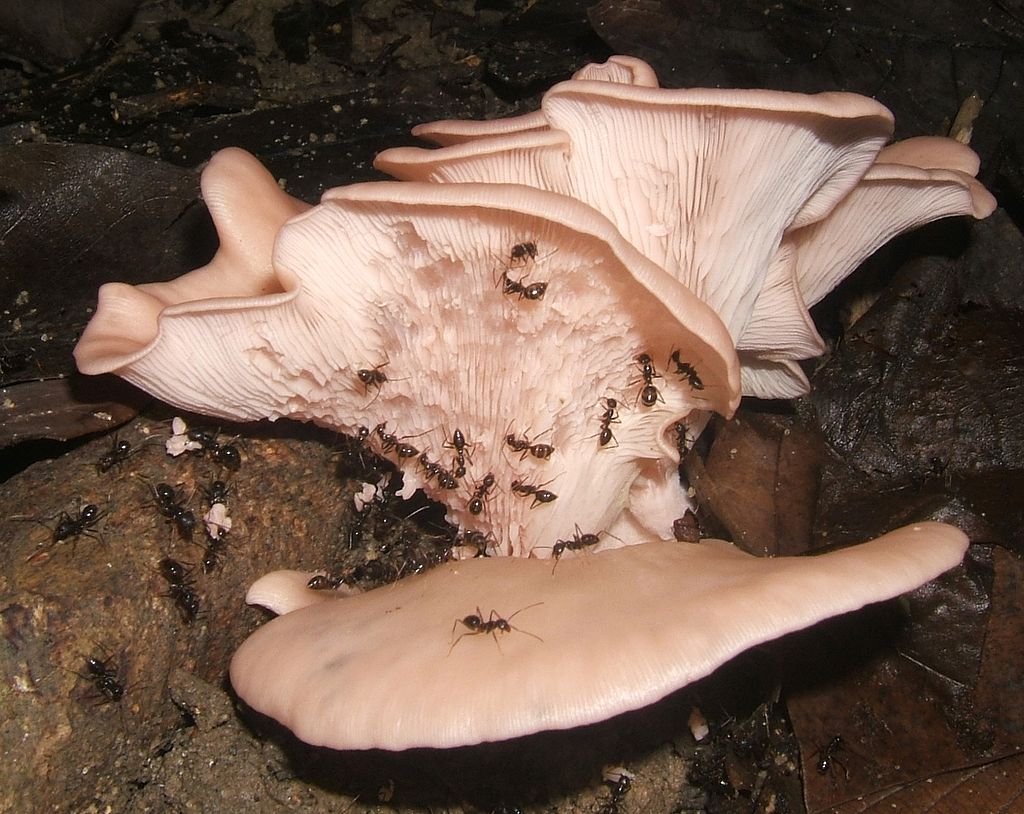
Yes, those are ants eating ‘shrooms. This ant species, Euprenolepis procera, hunts for mushrooms at night in Malaysia and Indonesia. As reported by Witte and Ulrich, a colony uses preformed cavities as temporary nests for only one to nine days, and then moves on to more mushroomy pastures. Inside these temporary nests, ant workers “process fungal piles by intense mandible chewing”. Furthermore, “when retrieved from the nests, the fungal pulp had a characteristic sweetish-sour smell which was suggestive of fermentation”. Yum!
Although this food source is certainly quite delicious, the primary function of the nomadic, mushroom-harvesting lifestyle may be to minimize competition with other ants. Deriving nutrients from mushrooms requires a high degree of specialization in the ants, possibly involving co-evolved endosymbiotic bacteria. Once they jumped that evolutionary hurdle, these ants may have been able to persist in competitive, tropical environments by utilizing a resource that is effectively unavailable to potential competitors.
We don’t yet know for sure how this behavior evolved. What we do know is that the mushroom harvesting of these Southeast Asian ants undoubtedly ranks as the most exciting style of nomadic behavior… for now!


 The Daily Ant
Leave a reply to Derek Langston Cancel reply