Many thanks to Worker Correspondant Jason Bates, who sent us this video by the BBC, which could also be called “Until the cows come home”:
Myrmecology Dies in Darkness
Many thanks to Worker Correspondant Jason Bates, who sent us this video by the BBC, which could also be called “Until the cows come home”:
There is perhaps no tale as ancient as the tale of a human hell-bent on keeping ants out of their home. It’s no surprise that we chose to launch this outlet, over two and a half years ago, with a treatise in defense of house ants. Surely no one, by now, is shocked at the freshest antagonistic plot the humans have cooked up: “eco-friendly” slippery paints.
A cohort of human scientists, led by Aurélie Féat (an “Industrial PhD student” at AkzoNobel), recently reported their anti-antvention in Progress in Organic Coatings. They describe how the special paint coating, when above a certain “critical Pigment Volume Concentration” (CPVC), results in loose particles detaching when ants walk across the surface. These rogue particles subsequently adhere to ant tarsi pads and cause the poor sisters to slip, preventing movement up a wall. See for yourself how this band of scientists “fouled” the tarsi of Atta cephalotes leaf-cutter ants with “contaminating particles”:

The study authors claim that this novel waterborne and organic paint coating substance is more “eco-friendly” than insecticides. But does any product designed to repel our formicid friends deserve such a generous descriptor? We’ll let our readers decide.
The Daily Ant hosts a weekly series, Philosophy Phridays, in which real philosophers share their thoughts at the intersection of ants and philosophy. This interview with Dr. Vida Yao is the 67th contribution in the series.
Dr. Vida Yao sat down with The Daily Ant to discuss graciousness, implicit bias, boredom, ant puns, and more. Enjoy!
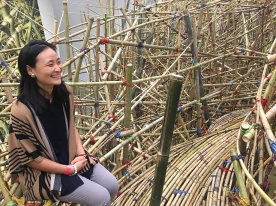 Dr. Vida Yao is Assistant Professor of Philosophy at Rice University. She received her Ph.D. at UNC Chapel Hill in 2016 and did her undergraduate work at the University of British Columbia and UC Berkeley, as a Killam-Fulbright Fellow. She works in ethics and moral psychology, has written on boredom, weakness of will, the guise of the good thesis, and implicit bias, and organizes the Rice Workshop in Humanistic Ethics. She regularly teaches classes on the history of ethics, death, and feminist philosophy, and is currently working on a monograph on grace and the virtue of graciousness. You can follow her on Instagram @vida.philosophy.
Continuing the long, lovely, storied history of ant comics by Poorly Drawn Lines, here is a playful comic, “Blocked“, from about 6 months ago (and trust us… it won’t be the last PDL ant comic – stay tuned):
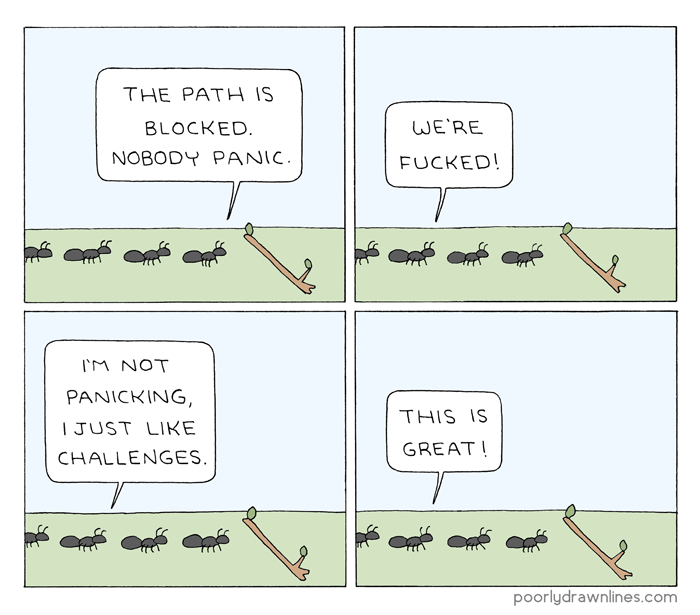
Of course, as is so often the case, we have our antrepid Comic Correspondant Matt Hernandez to thank for bringing this to our attention! They are a true antspiration to us all!
It should come as a surprise to no one – vertebrate or invertebrate – that a song (mostly) about an ant won a 1959 Oscar for Best Original Song. That song, “High Hopes“, is a charming ditty, as you can see and hear in the embedded video, below. The most antspirational lyrics are as follows:
Next time you’re found, with your chin on the ground
There a lot to be learned, so look around
Just what makes that little old ant
Think he’ll move that rubber tree plant
Anyone knows an ant, can’t
Move a rubber tree plant
But he’s got high hopes, he’s got high hopes
He’s got high apple pie, in the sky hopes
So any time you’re gettin’ low
‘Stead of lettin’ go
Just remember that ant
Oops, there goes another rubber tree plant
Oops, there goes another rubber tree plant
Oops, there goes another rubber tree plant
This is… a wonderful animation about army ants. A retweet by myrmecologist Dr. Adrian Smith brought the video to our attention, so we’ll be one of the only ones to say it this week: Thank you, Twitter!
Watch “The World War of the Ants – The Army Ant”, by Kurzgesagt, now:
The Daily Ant hosts a weekly series, Philosophy Phridays, in which real philosophers share their thoughts at the intersection of ants and philosophy. This is the sixty-sixth contribution in the series, submitted by Dr. Eric Wiland.
Colonies and the Common Weal
Some ant colonies thrive. Others don’t. In many cases, myrmecologists can tell us what it is for one or the other to obtain well-being — although, like Tolstoy’s quip about the unhappiness of families, I’m guessing each struggling ant colony is suffering in its own way.

If economists were to theorize about the well-being of ant colonies, they would likely proceed by first calculating the well-being of each individual ant in the colony, and then adding up the results to arrive at a measure for the well-being of the colony as a whole. Or perhaps they would average the results. Either way, they would study the well-being of ant colonies by first studying the well-being of ants, and then doing some math.
There seems to be something right and something wrong with this approach. It would be weird to think that the well-being of an ant colony has nothing whatsoever to do the well-being of the ants constituting the colony. Could there be a thriving colony all of whose members are unwell? Unlikely. It does seem like the well-being of the colony has something to do with the well-being of its members.
On the other hand, what it is for an ant colony to be well off is not just for its individuals ants to be doing well. The colony can thrive (or fail to thrive) in ways that don’t register merely on the level of the individual ants. Sometimes, a particular ant might do better for itself by harming (or at least leaving) the colony. At other times, the well-being of the colony might not be great for its current members, but the colony achieves something for a not-yet-existing generation, thereby doing well for itself. Ant colonies might last longer than any ant who is a member of it. It sometimes almost looks as if the ant colony is itself an organism with parts, both spatial and temporal.

I’ve recently become interested in analogous questions about human beings. What is it for a group of human beings (e.g, a polis, a labor union, a family) to be well off, and how does this relate to the well-being of the individuals who constitute the group? Lots of philosophers now study groups, but no one really studies what it is for a group to be doing well or badly. Lots of philosophers now study well-being, but they all focus on the well-being of individuals. It’s weird that there’s this lacuna in the literature. How should it be filled?
I can think of four basic ways the well-being of a group might be related to the well-being of the individuals in the group. There’s the economic way mentioned above: figure out the well-being of each individual in the group, and then apply some mathematical function to the tally. I call this the functional conception of group well-being. The well-being of an ant colony, on this view, essentially depends only upon the well-being of its ants. [Metaphysicians, take note of the word ‘essentially’ here. I’m not talking about efficient-causal dependence.]
We might instead think that there’s just no such thing as group well-being, that groups just can’t be better or worse off. Only individuals can be well or ill. I know of no one who explicitly endorses this view, but Jordan Peterson has recently written some things that seem to imply it. Call this the eliminativist conception of group well-being. On this view, ant colonies are the wrong kind of thing to be better or worse off.

You might also think that the well-being of a group floats entirely freely of the well-being of the individuals constituting it. Whether a group is well off, then, would essentially depend entirely on matters other than the well-being of the individuals in the group. Perhaps the group’s well-being depends upon achieving its mission or upon its longevity. This seems to be what many anti-totalitarian theorists presume and thus worry about. Call this the independent conception of group well-being. On this view, the well-being of an ant colony in no way essentially depends upon the well-being of its ants.
Finally, you might try to interpolate between the functional conception and the independent conception. Suppose that the well-being of a group essentially depends in part upon the well-being of the individuals in the group, and in part upon other stuff. The well-being of a group, then, would bear a complex relation to the rest of the world. Damaging the well-being of some individual would then damage the well-being of the groups to which they belong, but a group’s well-being can also depend upon things other than the well-being of its members. Call this the partial conception of group well-being.
Which of these four conceptions is true? I am unsure. But I suspect that each conception accurately describes some groups. Groups vary widely in their structure, and this might shape how the well-being of a group relates to the well-being of its members. This, however, is just a hunch. But if this is right, then thinking about well-being can help understand the different forms of groups there are.
An even more interesting question, I think, concerns the direction of possible dependence between the well-being of a group and the well-being of its members. Recall that economists presume that the well-being of a group depends upon that of its members. Maybe so. Call this bottom-up dependence.
But we should also consider the other direction. Perhaps the well-being of an individual depends (in part) upon the well-being of the groups to which they belong. If this is so, then when the groups you belong to do better, you thus do better. If this describes ant colonies, then when an ant colony suffers, all of its members thereby suffer too. Call this top-down dependence.
I’m not sure whether there really is top-down dependence. And I certainly don’t know whether the well-being of an ant essentially depends upon the well-being of its colony. It surely causally depends upon all kinds of facts about its colony, but does it essentially depend upon the well-being (as opposed to some other feature) of its colony? I’m eager to know.
 Dr. Eric Wiland is Professor of Philosophy at the University of Missouri – St. Louis. He is the author of Reasons, is working on a book about advice, organizes SLACRR, and goofs around with an upright bass.
Who’s missed us? Let us know in the comments, before or after you’ve watched “Uncle Donald’s Ants”, from 1952.
If you are reading this sentence, it is more likely than not that you’re aware of our Sunday poetry series, Formicid Form. Yet this series may be a little too mainstream for your tastes, and you may desire something more creative. Is that so? Then check out this step-by-step guide on how to get leaf-cutter ants to write poetry for you! Many thanks to Labour Correspondant Laura Southcott for sending this along.
The Daily Ant hosts a weekly series, Philosophy Phridays, in which real philosophers share their thoughts at the intersection of ants and philosophy. This is the sixty-fifth contribution in the series, submitted by Dr. Luke Roelofs.
Anty-Nesting and Anty-Combination
Here’s a question: are ants conscious? Here’s another question: are ant colonies conscious? I’m not going to defend an answer to either of these questions, but I do want to defend ‘compatibilism’ about positive answers to them. I think that, whether or not ants are conscious, their being conscious wouldn’t be a problem for the colony itself being conscious; likewise, whether or not colonies are conscious, their being so wouldn’t by itself imply that their members weren’t.
Some philosophers deny this: they’re ‘incompatibilists’ about ant-consciousness and colony-consciousness, because they endorse what Eric Schwitzgebel calls an ‘anti-nesting’ principle (2015, p. 1702). For example, Hilary Putnam, in an influential early discussion of what would come to be called ‘functionalism’, stipulates, in his suggested schematic definition of ‘pain’, that “No organism capable of feeling pain possesses a decomposition into parts which separately [satisfy this definition]”, this stipulation being intended “to rule out such ‘organisms’… as swarms of bees as single pain-feelers” (1965, p. 163). Bees being just the flower-themed sisters of ants, we may assume that ant colonies are also meant to be ruled out here.
Taken at face value, this might seem to imply clear absurdities: Ned Block points out that if it rules out having even one sentient part, then potentially “pregnant women and people with sentient parasites will fail to count as pain-feeling organisms” (Block 1978, p. 291). A more plausible reading would be that Putnam means to rule out cases where, as Block puts it, conscious parts of something “play a crucial role in” the whole being conscious. Even then, we might wonder what the motivation is for this principle. Unfortunately, as Schwitzgebel notes, Putnam “doesn’t explain why this possibility is absurd for actual swarms of bees, much less [for any] possible future evolutionary development of a swarm of conscious bees…” (2015, p. 1702).
A more developed defence of Anti-Nesting comes in Giulio Tononi’s explanation of what he calls ‘the exclusion principle’, part of his ‘Information Integration Theory of Consciousness’ (2009, 2012). Consciousness is integrated information, but not all integrated information is conscious; if a system is contained within a supersystem with equal or greater informational integration, or contains a subsystem with greater, it cannot be conscious. That doesn’t by itself tell us whether colonies or ants would win out, or what sort of consciousness they have, but it does guarantee that they are ‘in competition’ for consciousness. In a way that somewhat echoes the disputes Jack Samuel discusses in a prior contribution to this series, about whether to prefer individual or collective levels of explanation. The exclusion principle tells us that one level must be privileged over the other.
But why? One rationale Tononi offers for this principle is parsimony, ‘Occam’s razor’. François Kammerer, defending his own more limited anti-nesting principle, says something similar:
“[Anti-nesting] can be seen as a consequence of a broader principle that seems to be an important prima facieconstraint on our theories of consciousness: one should not needlessly multiply ascriptions of consciousness, which is itself a specialized version of Occam’s Razor.” (2015, p. 1055)
To allow nesting would be unparsimonious, since given the whole, we gain nothing explanatorily by positing additional, ‘less conscious’, complexes.
But this isn’t how we think about parsimony in other cases. Given the existence of four table legs and a tabletop attached to them, the existence of a table adds nothing: the table causes only those effects that its parts do. But we would normally never think this made it unparsimonious to accept that tables exist, though some philosophers do draw that conclusion (e.g. Merricks 2001). The normal way to think here is that recognising the existence and powers of wholes isn’t an additional posit at all, not the kind of ‘needless multiplication of entities’ that Ockham’s razor would slice at. What I’m drinking my coffee out of is both a single mug, and trillions and trillions of atoms: neither of these descriptions undermines or competes with the other.
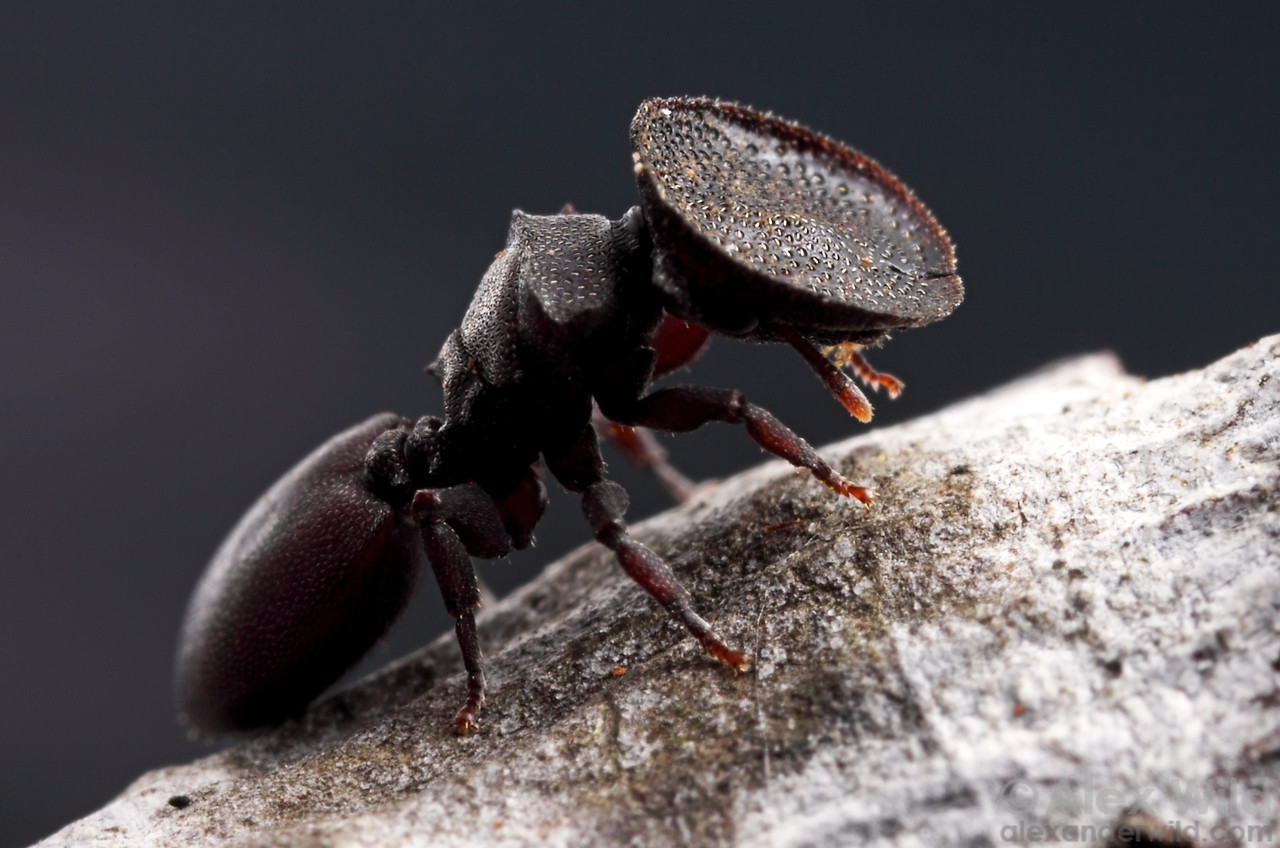
Not only does the parsimony argument fail to support Tononi’s exclusion principle, there are intuitive arguments against it. My favourite example appeared in a previous post here by Schwitzgebel (another example is Block 1978, pp. 291-292). He describes the ‘Antarean Antheads’: outwardly elephantine aliens from a planet near Antares whose ‘brains’ are in fact a swarm of minute insects, individually conscious but of rudimentary intelligence, living inside a ‘mobile hive’ which their aggregate wrigglings and scent signals control intelligently just as our bodies are intelligently controlled by the aggregate synaptic firings of our trillion neurons. As Schwitzgebel argues in the paper that post excerpts, it would be grossly implausible, not to mention decidedly unfriendly, for humans to re-interpret the Antheads’ actions and utterances (in which they come across as “sanitary, friendly, and excellent conversationalists”, 2015, p. 1701) as non-conscious as soon as they discovered what their brains were made of.
I find this argument very convincing, and the parsimony argument very unconvincing. Yet there is still this sense of puzzlement that floats around the idea of minds composed of other minds. Historically, for instance, dualist philosophers like Descartes, Plotinus, and Ibn Sina have all made arguments along roughly the following lines: all material things are divisible into parts, but minds have a special unity that makes them indivisible, so they cannot be material. Not many people make this argument any more, but I think the intuitions that it draws upon are still around, and the appeal of anti-nesting principles is a manifestation of them.
Here’s something else Tononi says to justify his exclusion principle:
“No matter how hard I try, I cannot become conscious of what is going on within the modules in my brain that perform language parsing: I hear and understand an English sentence, but I have no conscious access to how the relevant part of my brain are achieving this computation, although of course they must be connected to those other parts that give rise to my present consciousness…” (2012, p. 276)
At first glance this argument seems incomplete. After all, the fact that I lack conscious access to a given process doesn’t entail that the process is not itself conscious. If an ant colony is conscious, then it might not have access to all the same information that each individual ant is: why should that entail that the ants themselves aren’t conscious of that information?
I think Tononi is gesturing in the direction of the following thought: if a conscious whole had conscious parts, its consciousness would have theirs as parts, so that their streams of consciousness were elements within its stream of consciousness. Its experiences would also include their experiences, so that by attending to the experiences the whole shared with a particular part, it could ‘introspect onto someone else’s mind’. And this, we’re meant to think, is problematic.
I think this is an interesting argument, but it fails as an argument for anti-nesting, because that first step – “if a conscious whole had conscious parts, its consciousness would have theirs as parts” – is false. That’s what Block’s example of the sentient parasite illustrates: the existence of conscious parts of me doesn’t by itself guarantee any relationship between their consciousness and mine.
But Tononi’s worry here is still pointing at something important: not anti-nesting, but rather a principle I call ‘anti-combination’:
Anti-Combination: The experiential properties of a conscious subject cannot be mere combinations of the experiential properties of other subjects which compose it.
By ‘mere combinations’ I mean something like ‘composed of and fully explained by’: if my consciousness is a mere combination of three other consciousnesses, that means it’s nothing but those three, together. I think anti-combination has a grip on our imaginations, and anti-nesting principles, though they don’t follow from it, are motivated by our intuition that there’s something weird and confusing about the idea of minds entirely composed of other minds.
But guess what! I think that weird and confusing idea is actually true, and minds built out of other minds may be quite common. In fact, I just wrote a book, Combining Minds, that aims to analyse, clarify, and ultimately refute anti-combination. If you’re interested in knowing more about it, you can order it here, or read my posts about it on the Brains Blog here. If I’m right, then we ourselves may be more like ant colonies (and swarms of bees, and Antarean Antheads) than we seem.
References:
Block, N. (1978). “Troubles with Functionalism.” Minnesota Studies in the Philosophy of Science 9:261-325.
Kammer, F. (2015). “How a Materialist Can Deny That the United States is Probably Conscious – Response to Schwitzgebel.” Philosophia 43:1047–1057.
Roelofs, L. (2019). Combining Minds. Oxford University Press.
Putnam, H. (1965). “Psychological predicates.” In W. H. Capitan & D. D. Merrill (Eds.), Art, mind, and religion. Liverpool: University of Pittsburgh Press.
Schwitzgebel, E. (2015). “If Materialism Is True, the United States Is Probably Conscious.” Philosophical Studies 172: 1697–1721.
Schwitzgebel, E. (2017). “Antarean Antheads.” The Daily Ant. https://dailyant.com/2017/10/27/philosophy-phriday-antarean-antheads/
Samuel, Jack. (2018). “Unity and Antnihilation.” The Daily Ant. https://dailyant.com/2018/02/02/philosophy-phriday-unity-and-antnihilation/
Tononi, G. and Balduzzi, D. (2009). “Qualia: The Geometry of Integrated Information.” Computational Biology 5 (8): 1-24.
Tononi, G. (2012). “Integrated information theory of consciousness: an updated account.” Archives Italiennes de Biologie 150 (2-3): 56-90.
 Dr. Luke Roelofs is a postdoc at the Ruhr-University Bochum, and certainly not a colony of ants piloting a human-shaped vehicle. He works on a bunch of things: panpsychism, collective agency, and most recently the philosophy of imagination. And, just to emphasise, not an ant colony in disguise. His current project, ‘Reason, Empathy, and the Minds of Others’, focuses on meta-ethics and social cognition, and just for the record, he is definitely human, not 20 million ants cooperating to infiltrate human academia.
We know what you are thinking. Indeed, our production of premier ant content for general consumption has been flagging lately. It’s true, we haven’t posted a non-Philosophy Phridays article in quite a long time. Could it be a conspiracy? Has Big Vertebrate succeeded in silencing our noble cause? Could chemtrails be to blame?
Well, we don’t know much about chemtrails – and our officially stated reason for our relative silence is our staff’s preoccupation with external affairs – but we do know something about chemical trails laid by ants. Thankfully, as shared with us by YouTube Correspondant John Turner, we’re not the only ones: Enter AntBot.
Recent efforts by a team of researchers at Aix-Marseille University (AMU) produced a stellar robot that utilizes the methods of desert ants to navigate in an extraordinarily accurate fashion. As reported in Science Magazine:
That limited brainpower [of desert ants] made it possible for researchers to accomplish the same tasks using relatively simple computer processors. To establish its heading, “AntBot”—which has six insectlike legs and two simple eyes—uses an eye designed to detect the sun’s ultraviolet light and a pair of rotating polarizing filters to determine its relative position. Just like the desert ants, AntBot also counts its steps and monitors the speed of the ground flowing past. In an era where resolution is measured in megapixels, AntBot’s eyes have just 14 pixels between them.
Want to see AntBot in action? Marvel at the video below.
The Daily Ant hosts a weekly series, Philosophy Phridays, in which real philosophers share their thoughts at the intersection of ants and philosophy. This is the sixty-fourth contribution in the series, submitted by Dr. Briana Toole.
To Follow Blindly – Army Ants and Echo Chambers
Ant hills dominated the backyard of my childhood home. I once had the misfortune of falling into one. While I felt a momentary pang of regret at damaging their home – which I often spent my free hours admiring – I felt sorrier for myself, covered in painful and itchy bites. Though I bear no ill will to the ants, I did suddenly understand why some children, in the ultimate act of vengeance, try to burn ants with a magnifying glass. But for all you psychopaths out there, there is a much cooler (read: crueler) way to kill ants. Well, army ants, anyways.
Army ants, unlike your garden-variety ant, are completely blind, and navigate by following the pheromone trails left behind by others. But, if they lose the scent, they respond by following the ant immediately in front of them. Owing to their lack of sight, they will march around in a loop until they drop dead. As it turns out, one can force army ants en masse into these ‘death spirals’ by simply diverting them into a closed circuit.
It’s easy to pity the army ant, who does nothing other than what nature has programmed her to do. It is but a cruel trick of nature that she can be manipulated so to turn against herself, leading her slowly but faithfully to her death. But are humans so different?
Much like army ants may fall prey to death spirals, humans are subject to a similar phenomenon known as echo chambers. Echo chambers are closed circuits in which an individual’s beliefs are amplified or reinforced. But where ants are lead to mass suicide, humans are led into thinking their ill-founded beliefs are better supported than they actually are.
Now myrmecologists are the folks who study the utterly bizarre behavior of ants and why they’re prone to death spirals. But it’s philosophers, and epistemologists specifically, who explore how this behavior can be mirrored in humans. Epistemologists are concerned with studying knowledge. One reason we study knowledge is that we care about truth. Understanding what conditions must be satisfied for a belief to count as knowledge better enables us to get at the truth. Just as important, however, is exploring what features or behaviors make that task more difficult. Echo chambers might just be one such feature.
For comparison, think of pheromone trails like the holy grail in epistemology – the truth. As Robert Nozick argued, good epistemic agents track the truth – that is, if some proposition is true we believe it, but if that proposition weren’t true, then we wouldn’t believe it. This has come to be known as the ‘truth-tracking’ theory of knowledge1. In the same way that ‘good’ army ants track pheromone trails, good epistemic agents track the truth. But army ants can be lead astray – into death spirals. In being diverted, army ants ‘lose the scent’ of the pheromone trail, instead following blindly the ant in the lead, marching inevitably to their death. In much the same vein, echo chambers may divert us from the truth. So in echo chambers, even if some proposition is false, we might go on believing it anyways. We’ve lost track of the truth! How do echo chambers do this?
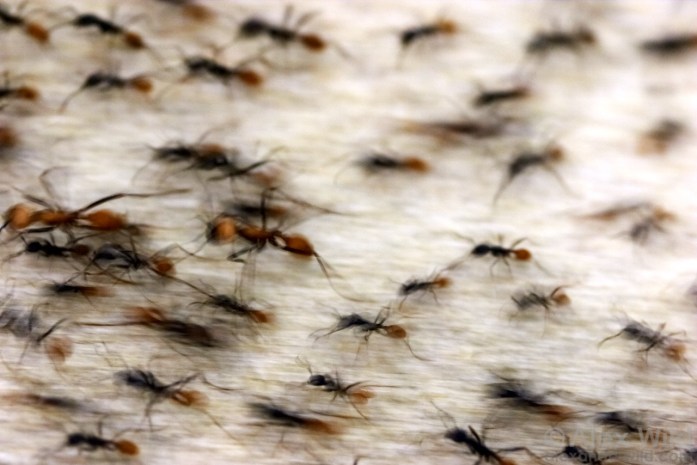
For starters, just as we can divert ants into a closed circuit, echo chambers are closed circuits in which our beliefs are amplified. This happens in two ways. First, our own beliefs are echoed back to us by others in the echo chamber who share our beliefs. This leads us to reason that our belief must be true, because others believe what we believe! Second, echo chambers actively discredit those who voice contrary views. This leads us to reject evidence that might ultimately show us our own belief is false.
Now, let’s consider an echo chamber out in the wild – anti-vaxxers. Anti-vaxxers hold the false belief that vaccinations cause autism, among other issues. The anti-vax movement thrives through the creation of social media echo chambers – on Facebook, Twitter, and similar social media platforms. These anti-vax social media groups become filled with individuals who already believe that vaccinations are dangerous. And, from the fact that everyone in the group agrees that vaccinations lead to autism, my confidence in this belief becomes strengthened. After all, why would so many people believe it if it were untrue?
Moreover, members of these groups already have prejudicial beliefs about those who hold contrary views. Anti-vaxers tend to believe, for instance, that those who advocate for vaccinations are aligned with ‘big pharma’. As such, they take those who are pro-vaccine to be less credible. Consequently, anti-vaxxers systematically alienate themselves from epistemic resources offering information that might lead them to realize their belief is false.
One worry with echo chambers is that they make us susceptible to a certain kind of epistemic vice known as bootstrapping2. Imagine that I’m gossiping to a friend who, unbeknownst to me, is a journalist for a popular, and generally reliable, gossip-rag. I casually mention that I’ve heard rumors that Angelina and Brad are reuniting. My friend then writes this up in her magazine and I see it on the stands the next day. This then strengthens my belief that Angelina and Brad really are getting back together! But my justification for believing this (that it was printed in a magazine) presupposes the reliability of the story’s source (which is me!).
Applied to our case of the anti-vaxxer echo chamber, we can see that by filling a group with like-minded individuals, I can create a similar sort of epistemic circularity. I convince myself that there’s more evidence for my belief than there actually is, just by surrounding myself with people who already believe what I believe. And we can see parallels between the anti-vaxxer echo chamber and a number of other closed circuits, ranging from flat-earthers to climate change deniers.
Of course, echo chambers aren’t as dangerous as army ant death spirals. While it’s certainly true that we don’t drive ourselves to mass suicide every time we lose track of the truth, there is a danger near. Just look at the consequences of the success of the anti-vax movement. As a result, fewer and fewer people, especially children, are receiving vaccinations. Consequently, we’ve seen an uptick in measles, previously considered eliminated, as well as polio and whooping cough3. Failing to follow the pheromone trail can have disastrous consequences for the wandering ant. So, too, can failing to follow the truth!
1Robert Nozick, “Knowledge,” Philosophical Explanations (Cambridge: Cambridge University Press, 1981).
2Jonathan Weisberg, “The Bootstrapping Problem,” Philosophy Compass (2012)
3Anti-Vaccination Movement Causes a Deadly Year in the U.S
 Dr. Briana Toole is a Post-Doctoral Fellow in philosophy at Baruch College, CUNY. She lives above a deli and yet her apartment has somehow attracted no ants. Suspicious. Dr. B is an accomplished watcher of television and in her spare time enjoys writing philosophy. She is also the director of the philosophy outreach program, Corrupt the Youth, which aims to bring philosophy to populations that lack access to it.
 The Daily Ant