The Daily Ant
Myrmecology Dies in Darkness
Category: Reports
-
We know what you are thinking. Indeed, our production of premier ant content for general consumption has been flagging lately. It’s true, we haven’t posted a non-Philosophy Phridays article in quite a long time. Could it be a conspiracy? Has Big Vertebrate succeeded in silencing our noble cause? Could chemtrails be to blame? Well, we don’t…
-
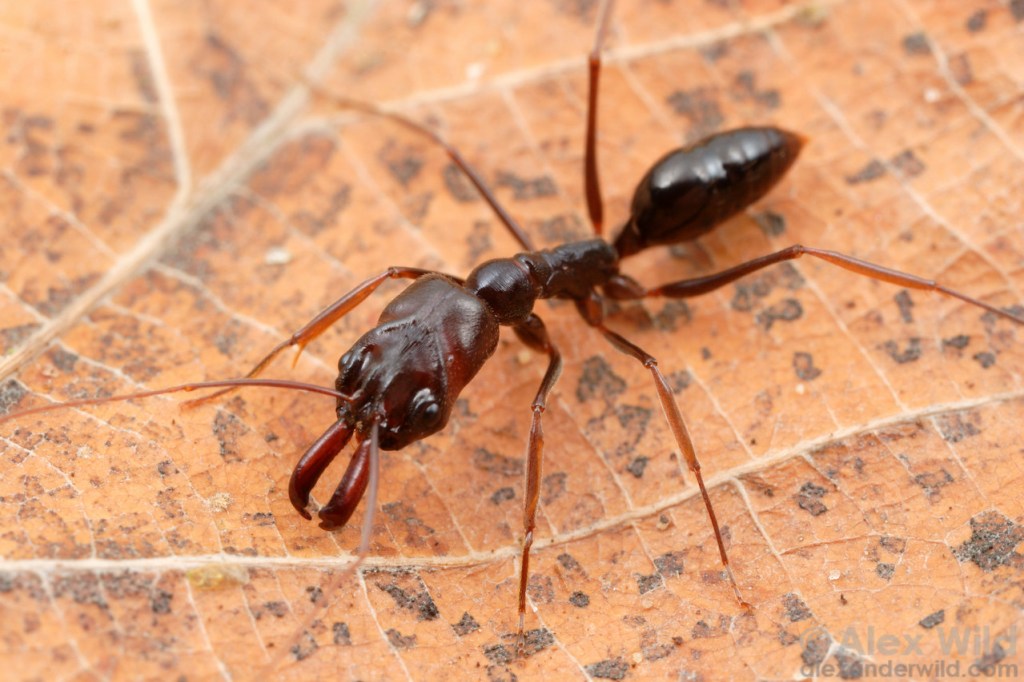
This intimidating ant is a species in the genus Odontomachus: Observe the powerful mandibles, the large eyes, the menacing form. Conventional wisdom must assume that such a fierce warrior is a natural winner in the horse ant race that is life. Get ready for the upset. This pleasant ant is a species in the genus Formica: Charm…
-

Earlier this week, a staff member at Rutgers – Camden Campus News reached out to The Daily Ant with an exciting press release. The release highlights the work of Sammy Schofield, a researcher and undergraduate student in Dr. Amy Savage lab: Schofield’s project examines how fine-scale habitat complexity affects the diversity of species of arthropods such as ants in…
-
We already know that spiny ants are cool. But did you know that the first well-documented case of directed, intentional swimming by ants is in the spiny ant genus, Polyrhachis? Maybe we’re biased, but we think you will definitely want to watch this classic BBC Earth video of the ant-paddling Polyrhachis sokolova:
-
We’ve once again fallen rather silent for over two weeks, yet throughout the past month or so, our devoted readership has sent us a steady supply of premier ant content. Below, we present you a list of seven interesting items we almost allowed you to miss!
-
Are you interested in the phrase “dangling ant asses”? Of course you are. Thus, you will now use a mere 5 minutes to listen to this fantasstic 2013 podcast about honeypot ants, by Dr. Elizabeth Wason: [Podcast Source: hugabug]
-
Basically, we just like the name of Xymmer, an ant genus with two known species found mostly in Africa but also reported from Southeast Asia.
-
The great Swiss myrmecologist Auguste Forel (1848 – 1931) once observed that “the greatest enemies of ants are other ants, just as the greatest enemies of men are other men.” In general, this maxim appears true – with exceptions. Once such exception was reported in 1977 in the journal Nature, by myrmecologists James H. Brown…
-
Cemeteries are known locations of an abundance of human bones. But cemeteries are not the only site where human bones have been deposited, in both modern and ancient times, and investigations of such bones, wherever they are found, can often tell us a lot about traumatic injuries, environmental changes, cultural histories, and a number of…
-
There is an African ant species of tiny workers that lives in big trees. In these big trees, the little ants scurry around long, narrow cavities in the bark, tending to the even littler insects they harvest as livestock. Outside of these big trees, the little ants can barely stand. The difficulty that the gals…
-
One of the more stunning biological discoveries to date is that organisms like ants are not merely individual organisms, but also hosts to trillions of bacteria. Some biologists have increasingly focused on this “microbiome”, and naturally work in ants is no exception. A few months ago, a group of ant researchers discovered yet another cool…
-
If you’re anything like us, you’ve been spending a lot of time lately wondering about ant species coexistence. How can there possibly be 13,384 species of ants, when so many species have overlapping niches in space, food resources, and other traits? Shouldn’t the most competitive ant species ultimately drive all the others to extinction?
 The Daily Ant