• Are ants really that important? Clearly, readers of The Daily Ant ought to be settled on this question. But for the unantlightened, what strong evidence exists in the scientific literature to support the unique importance of ants in, say, tropical ecosystems? A skeptic could make the argument that such a view is only tentatively supported by qualitative assessments, back-of-the-envelope calculations, and inferences from rigorous but highly localized ecological tests. That is, until now!

    Enter our team of Hymenopteran heroes: Hannah Griffiths, Louise Ashton, Alice Walker, Fevziye Hasan, Theodore Evans, Paul Eggleton, and Catherine Parr.

    An antrepid crew! Alice Walker image unavailable.

    The fellowship of the wingless researchers set out to quantify the relative role of foraging worker ants on resource removal across a large ecological area, explicitly comparing the impact of the ant community to other invertebrates as well as vertebrates. Working in a tropical rainforest in Malaysia, this band of biologists set up different types of plots – one set excluded ants using an ant-targeting bait-based chemical treatment, another set excluded vertebrates, and the third set excluded both ants and vertebrates. Then, they placed a variety of baits in each plot, and assessed resource removal rate. Thus, the relative role of ants, non-ant invertebrates, and vertebrates could each be assessed, and the hypothesis of ant dominance tested. [Note: The authors explain that bearded pigs destroyed many of their bait stations, which were removed from analyses, but that “the likelihood of a station being attacked by pigs was not significantly affected by plot treatment, cage treatment or bait type.” Per usual, vertebrates try to meddle in the affairs of inverts, but to no avail!]

    What did the group of gregarious myrmecologists discover? Well, as reported in the Journal of Animal Ecology, they found ants to be of remarkable, irreplaceable importance. Specifically, ants contributed to no less than 52% of total bait removal, a percentage that the authors note is surely an underestimate, given that it was only possible to remove about 90% of ants in the ant removal treatment plot. Furthermore, this foraging impact was not compensated for when ants were excluded – that is, non-ant invertebrates were not up to the task of matching the rate of resource removal in absantia.
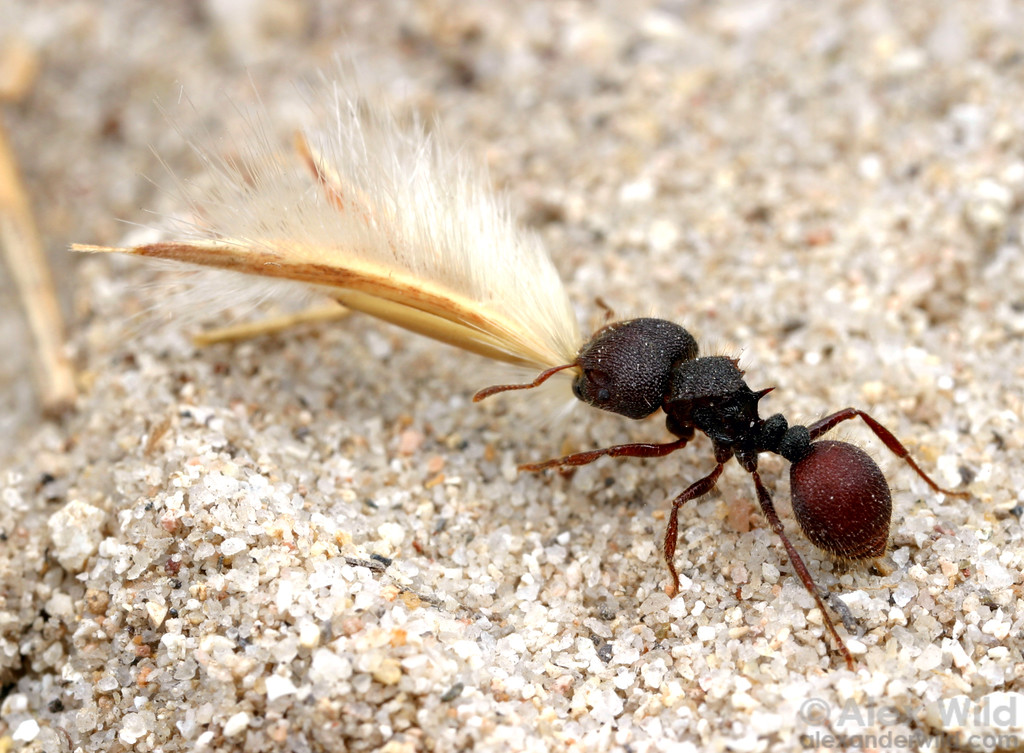
    SeedHarvester
    An ant doing her best to remove a resource. Photo: Alex Wild

    Although such an exciting documentation of ant dominance relative to other organisms was unnecessary for those who are already formicid-forward in their thinking, this rigorous work by Hannah Griffiths and colleagues provides a novel type of results that support the view, often held with certainty, that ants are the most functionally important group of macroscopic organisms in the tropics – and, indeed, the world!
  • The Daily Ant hosts a weekly series, Philosophy Phridays, in which real philosophers share their thoughts at the intersection of ants and philosophy. This is the twenty-fifth contribution in the series, submitted by Dr. Gabriel Richardson Lear.


    Aristotle and Myrmecology as a Humanistic Discipline

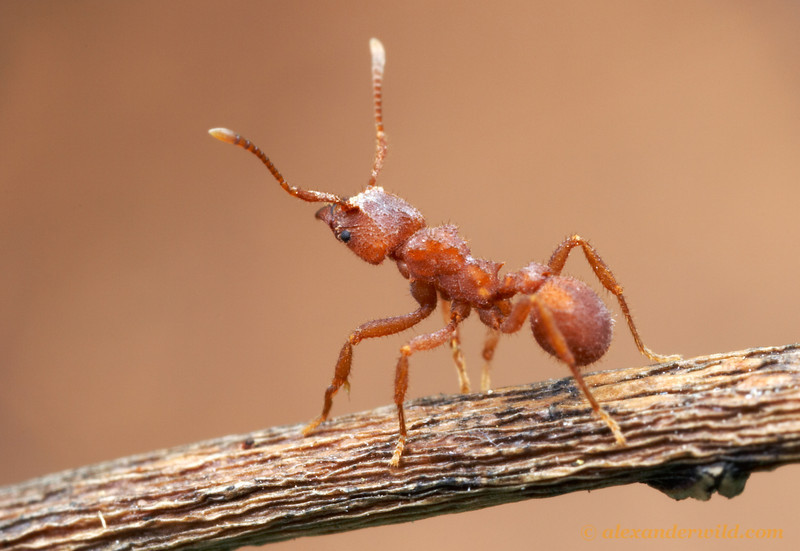
    “The study of ants is the way to self-knowledge.” Aristotle didn’t actually say that, but he might well have believed it. At least, there is a philosophical ambition to his approach to biology that invites self-reflection. Aristotle’s strategy in biology was to take vast quantities of data—some apparently his own observations; much of it reported by others—about all sorts of animals and categorize them on the basis of similarities and differences in their functional parts. So for example, all animals perceive—that, according to Aristotle, is just what distinguishes animals from plants—so all animals must have sense organs. But not all animals have all five senses; and even when a group of animals shares, say, the sense of smell, their noses vary in shape and proportionate size and in fact some of them—for example, the ant!—do not have noses at all. So, in creating the class of animals who smell, we include all animals with noses or some analogous organ. Aristotle’s recognition of functionally analogous parts in different species of animal is not only a major advance in the history of biology, it also invites philosophical reflection on what it means to be an animal and, in particular, to be the kind of animal we human beings are.

    Trachymyrmex.jpg
    The ant sniffs. “Smells like philosophy,” she declares.  Photo: Alex Wild

    (more…)

  • Style Saturday: Formicid Fashion — Fab & Frugal

    My antrepid readers will have noticed that Style Saturdays took a brief summer hiatus; I took a break for my brother’s wedding and some summer travel. In the meantime, I’ve heard from some formicid fashion fans that becoming a fashion-ant-sa is surprisingly expensive. Taking your lab look from drab to fab is probably always going to involve some measure of investment. Fashion – like most art – is beautiful but expensive. However, the truth is, you don’t need to break the bank to get a colony-couture look. Some of the myrmecological pieces featured thus far in the Style Saturdays series are genuinely unique, but it’s often pretty easy to get the rest of a look for less as long as you’re willing to improvise.

    Take this gorgeous ensemble pairing Yves Saint Laurent with beautiful jewelry from Alolo:

    The Lauren with Yves Saint Laur(a)nt

    Leather jewelry
    alolojewellery.com

    18k jewelry
    alolojewellery.com

    Fourmis
    lesqueuesdesardines.myshopify.com


    Here’s how to get a similar look for less. (With a little more surfing the web, or a willingness to thrift — you could get a similar look for even less!) These tights are expensive, but also amazing, and paired with less expensive clothes and jewelry, formicid fashion can be fab and frugal!

    The Lauren For Less

    J Crew j crew dress
    $93 – jcrew.com

    BP. black shoes
    nordstrom.com

    Claires jewelry
    claires.com
  • The Daily Ant hosts a weekly series, Philosophy Phridays, in which real philosophers share their thoughts at the intersection of ants and philosophy. This is the twenty-fourth contribution in the series, submitted by Suzanne Kawamleh.


    Ants and NGOs

    “Never doubt that a small group of thoughtful, committed citizens can change the world; indeed, it’s the only thing that ever has.”
    Margaret Mead 

    I work for a non-profit organization that aims to provide higher education opportunities to civilians inside war torn Syria, Promise for Relief and Human Development. We have a few other aims as well. We hope to provide an alternative to joining any one of the armed or extremist groups actively recruiting young men and women. We wish to encourage critical thinking. We want our campuses to serve as community centers with public lectures on relevant social issues like prescription drug abuse and psychosocial concerns like PTSD in war-ravaged civilian populations. We have achieved this amidst one of the worst man-made disasters since World War II. Missile strikes, chemical weapons, beheadings, and sexual violence as a weapon of war are standard fare in Syria. And yet, our students attend seminars, form study groups, and sit in exams. It is a striking example of organization amidst chaos and violence, one of the most astonishing successes to take place within the borders of a failed state.

    Organized.jpg
    Organization amidst chaos and violence. Photo: PRHD

    (more…)

  • Christian Alexander Stidsen Pinkalski and colleagues have a paper about ant poop forthcoming in the Journal of Ecology. Unfortunately, the full article is apparently not yet available online. But if the abstract is to be believed, the researchers confined weaver ants (Oecophylla smaragdina) to the canopy above coffee plants, and fed the ants a diet labelled with a particular version of nitrogen, 15N. This labelling approach allowed the researchers to differentiate between nitrogen derived from ants and that originating from other sources. Then, they tested the nitrogen profile of the coffee plants, and found that 15N uptake and overall nitrogen uptake was higher in the coffee plants below these canopy ants. This strongly suggests that nitrogen derived from ant poop is an important source of nitrogen in plant communities, and thus may be an under-appreciated component of the nutrient cycle. Well, shit!

    Oecophylla
    An ant with important poop. Photo: Alex Wild
  • Very few things have nothing to do with ants, and Anthony Scaramucci (or, as he is known in the adult cartoon we call reality, “The Mooch”) is no exception.

    Many readers will have only just recently learned their Moochian Myrmecology from intrepid journalist and gleeful polemicist Matt Taibbi. Who is Matt Taibbi? Well, let me put it this way. In 2005, Matt Taibbi wrote an essay called “The 52 Funniest Things About the Upcoming Death of the Pope” which, like Donald Trump, earned condemnation from both Hillary Clinton and Anthony Weiner. In 2012, he wrote this touching eulogy on the occasion of the actual death of Andrew Breitbart. In the very same year, he also wrote this love letter to David Brooks. (Which reminds me, I swear I once heard Ann Coulter describe David Brooks as the “Elisabeth Hasselbeck of the New York Times,” but I can’t find the reference.)

    Screen Shot 2017-07-30 at 10.53.35 AM
    See my problem?

    This year, Taibbi sets his sultry sights on an even lower target, The Mooch. And he has some choice myrmecological words for the guy.

    “While speaking of fellow White House spokesperson and new department subordinate Sarah Huckabee Sanders, “Mooch” delivered a line that read like a Mad Men screen test: “Sarah, if you’re watching, I loved the hair and makeup person that we had on Friday.” By the next day he was like a man with a sackful of ants turned over on his head, so many were the news stories denouncing him as sexist.”

    Zing! (What does the ant say, anyway?)

    Now, I happen to know that The Mooch will be none too pleased with the thought that a sackful of ants would be turned against him. How can I be so sure? Just look at his own second(?!) rule for “dealing with failing and turning it into success”:

    “Set Yourself up for Success. Success is hard work, audacity, grit, and courage. You have to be willing to be the ant. Remember, the grasshopper gets the shaft in the end. Associate with people who feel the same way.”

    That’s from page 58 of Scaramucci’s pathbreaking tome (or… philosophy paper? WTF? I thought PhilPapers was only for serious work!), Goodbye Gordon Gekko: How to Find Your Fortune Without Losing Your Soul.

    Now I know what you’re thinking: “Who does this son of a schmuck think he is— Jim Rohn?” But take it easy on The Mooch. First of all, Rohn passed away in 2009 (ahem – eulogy from Matt Taibbi, please?). Someone has to take up the torch of extremely substantive self-help myrmecology, and it sure as frackin’ frass ain’t gonna be me!


    350px-Jim-rohn-PASSES-AWAY
    Matt Taibbi has not written a eulogy for Jim Rohn.

    Second and more importantly, The Mooch had to endure years of working at Goldman Sachs. That takes real grit! After all, here is what Matt Taibbi has said about that bunch:

    “The first thing you need to know about Goldman Sachs is that it’s everywhere. The world’s most powerful investment bank is a great vampire squid wrapped around the face of humanity, relentlessly jamming its blood funnel into anything that smells like money. In fact, the history of the recent financial crisis, which doubles as a history of the rapid decline and fall of the suddenly swindled dry American empire, reads like a Who’s Who of Goldman Sachs graduates.”

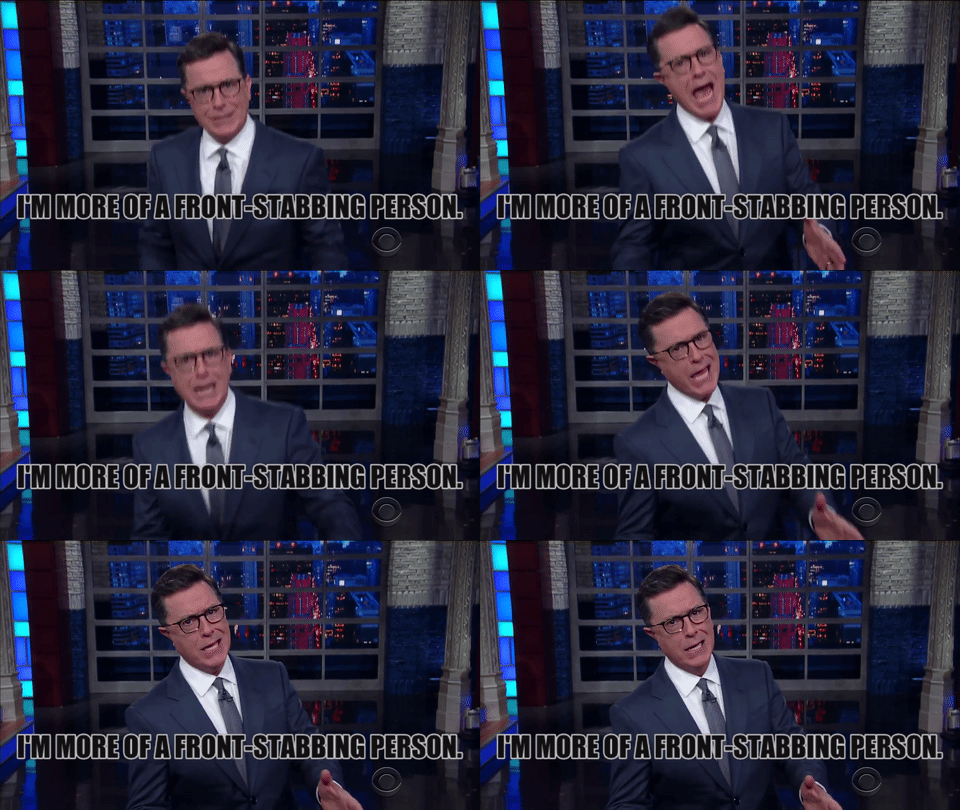
    Now, squid and ants don’t have much in common (though vampires and ants are a whole different kettle of fish), but there is enough to connect the dots. The point here is, The Mooch is trying. He’s trying to be the ant. He’s not trying to get the shaft. He’s trying to give the shaft. He’s trying to give the shiv. In the front.

    colbert


    “Boshua J’lanchard” is a pseudonym, as Boshua prefers to remain anonymous. S/he is a doctoral candidate in philosophy, specializing in metaethics, somewhere in the Chapel Hill, North Carolina region of the United States.


  • The Daily Ant hosts a weekly series, Philosophy Phridays, in which real philosophers share their thoughts at the intersection of ants and philosophy. This is the twenty-third contribution in the series, submitted by Dr. Michael Ruse.


    All About Ants:
    What Darwin the Scientist Learnt From Darwin the Christian and What That Tells Us About Darwinism Today

    Go to the ant, thou sluggard; consider her ways, and be wise:
    Which having no guide, overseer, or ruler,
    Provideth her meat in the summer, and gathereth her food in the harvest.
    (Proverbs 6: 6-8)

    Many people in American society today loathe and detest evolutionary thinking and have a special animus against the theory held by virtually all professional biologists, Charles Darwin’s theory of evolution through natural selection (Numbers 2006). This opposition by evangelical Christians and fellow travelers is understandable. You simply cannot accept Genesis taken literally – Adam and Eve in the Garden of Eden and their irresistible desire for forbidden fruit – and hold to modern thinking on paleoanthropology – the study of human origins. What is truly surprising is the extent to which Darwinism – by some, evolution even – is opposed by today’s leading professional philosophers. In recent works, noted thinkers Thomas Nagel (2012) and Jerry Fodor (Fodor and Piattelli-Palmarini 2010) have both written strongly against Darwinism. Alvin Plantinga (1991, 2011) doubts evolution itself and thinks Darwinism collapses in on itself.

    (more…)

  • Yesterday we observed a less-than-honest photographer on display. Today, we were happy to learn about a nice, short profile of renowned (and honest) photographer of ants (and other small critters), Alex Wild. The article, appearing in Wired, is worth a read – check it out!

    AlexWild.jpg
    Alex Wild. Photo by Alex Wild
  • Coding Correspondant Nathan Daly brought to our attention a remarkable photograph that went viral on Twitter last week.

    https://twitter.com/SimonNRicketts/status/887804157427675136

    (more…)

  • As the classic public service announcement goes, “If you see something, say something.” But adherence to this precept clearly generates a problem: if you don’t see something, you won’t say something! It is perhaps because of this mental framework that subterranean ants have received such little work in the scientific literature, compared to their aboveground sisters. Either that, or studying subterranean ants is really hard. Whatever the reason for this historical lack of premier underground ant content, a recent manuscript by Mark Wong and Benoit Guénard in Myrmecological News is exciting indeed.

    Are you interested yet? Of course you are. So, check out this great piece by the first author, which won the third-place Asian Scientist Writing Prize!

  • The Daily Ant hosts a weekly series, Philosophy Phridays, in which real philosophers share their thoughts at the intersection of ants and philosophy. This is the twenty-second contribution in the series, submitted by Chris Blake-Turner.


    Trantsformative Experience

    Let me start by making sure I say at least one true thing in this post: ants and humans are very different. I’m going to use this platitude to explore a problem that arises when we try to make some of the most important decisions in our lives. In particular, it seems that we can’t rationally decide: to have children; to change careers; to go to college.

    Leafcutter.jpg
    A leafcutter ant with its children in a colony. Photo: Alex Wild

    Consider the following two scenarios.

    (more…)

  • The Daily Ant hosts an intermittent ant film series, Theatre Thursdays. This is the second installment, by our Film Correspondant Derek Langston. Enjoy!


    Six-legged Celluloid Presents…
    A review of Ants on a Plane: “I’m tired of these mother formic ants on this mother formic plane!”

    DestinationInfestation

    When I decided to watch and review this film, I chose the rental option on Amazon. I was immediately greeted by a message along the lines of “Ordered by mistake? Click here to cancel order”, and I thought to myself, “This must be a warning from the gods of cinema”. Well boy were they right to warn me! What was to follow was an hour and a half of my life I will never get back. But fear not – my job is to weed out the crap from the quality when it comes to formicly-centered films so you, our faithful readers, don’t have to!

    (more…)