• The reproductive system of most ants is pretty freaky, by human standards. Unlike in our species, where all individuals have a diploid set of chromosomes, nearly all ant species utilize a “haplodiploid” system in which females are diploid and males are haploid, with only one chromosome for each chromosomal site. So, in order to produce males, a queen lays unfertilized eggs, while in order to produce females, the eggs must be fertilized.

    Chromosome.jpg
    A pleasing chromosome. Photo: Source

    (more…)

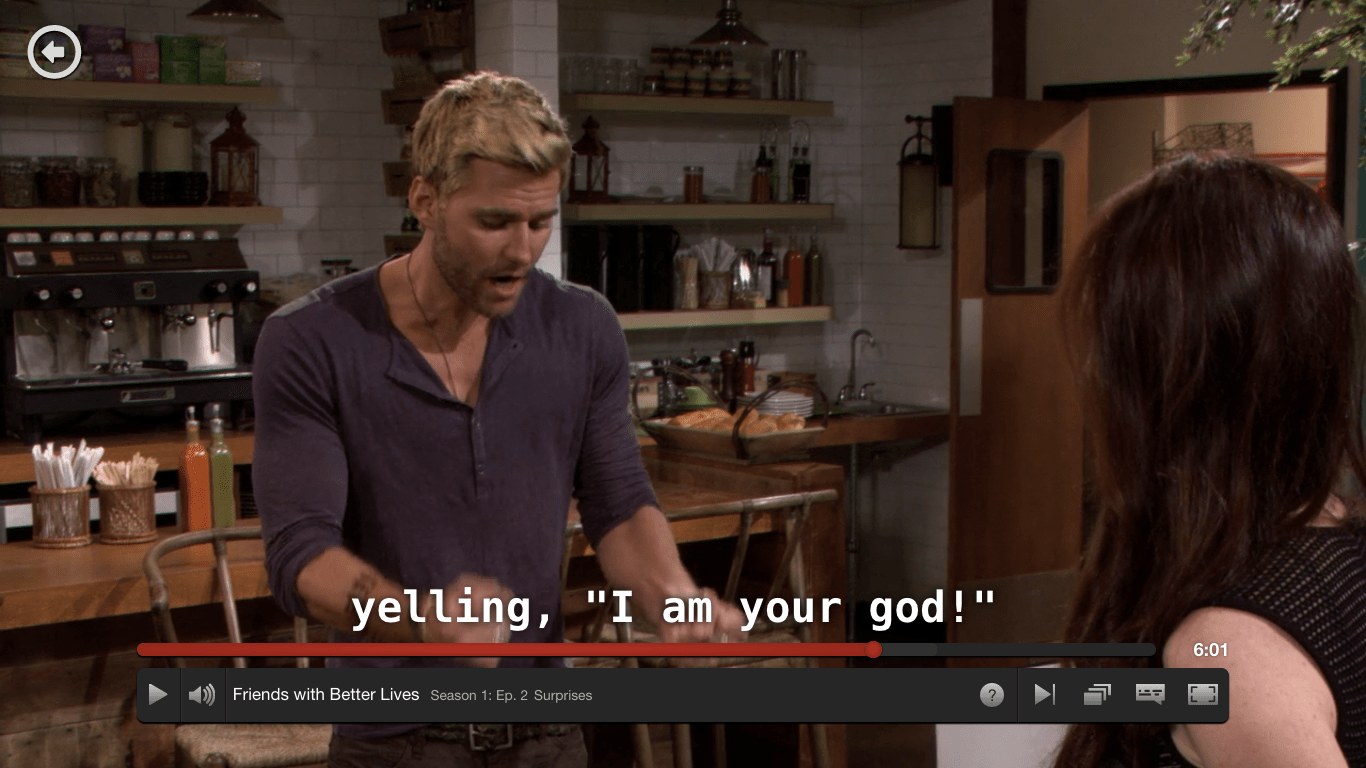
  • Tube Correspondant Katerina Theodossiou shared with us a shocking scene from the vertebrate television show Friends With Better Lives:

    17407927_10155314622429610_1679266217_o

    17373315_10155314622469610_1446546462_o

    Correspondant Theodossiou added:

    It’s from a show called friends with better lives
    It’s terrible
    I don’t know why I’m watching it
    It’s not good in any way
    Except that ants moment. That made me actually laugh out loud

    We can’t blame Theodossiou for momentarily falling prey to sneaky vertebrate humor from this anti-ant show. Thankfully, there is some evidence that formicid progress is beginning to take hold in mainstream culture: Friends With Better Lives was cancelled after only five episodes.

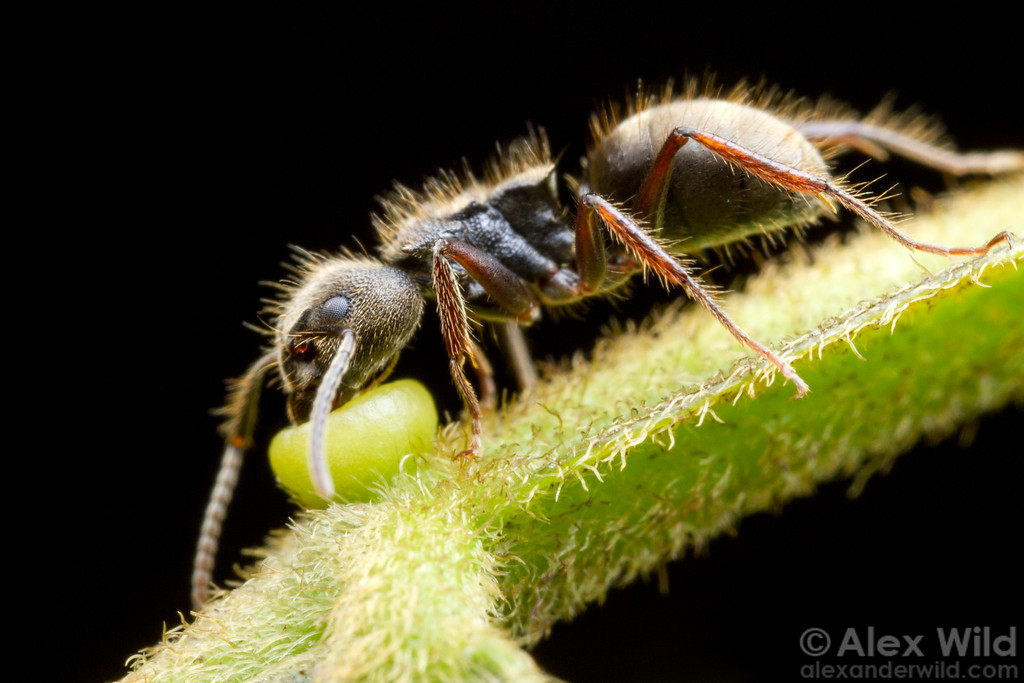
  • This is an extrafloral nectary:

    EFN
    Dolichoderus ant has a jolly old time at an EFN. Photo: Alex Wild

    Extrafloral nectaries, or “EFNs”, are little sources of sugar and nitrogen produced to entice ants to visit host plants. The plants, in return, enjoy the significant defensive capabilities of the ants, which often repel herbivorous insects. Given this benefit, it is perhaps not surprising that many different plant species and clades have evolved EFNs. But although these conspicuous structures have received much attention in the scientific literature, ants also benefit from a different, understudied “structure”: plant wounds.

    Like EFNs, plant wounds (typically caused by herbivore munching) also excrete sugar and amino acids. Of course, this only further damages the plant – or, does it? The authors of a recent study in The American Naturalist investigated the “ant-wound network” in subtropical Jianxi, China, and also considered the implications of their findings for theories of EFN evolution.

    The researchers (Dr. Michael Staab and colleagues) examined leaves from 10,000’s of trees over several years, documenting cases of ants feeding at herbivore-induced plant wounds and analyzing the nutrients present in wound sap via high-performance liquid chromatography. Their key finding was that 22 species fed on plant wound sap and did not exhibit specialization – plant wound feeding appears to be a facultative, opportunistic behavior in ants. Furthermore, the ant community feeding at plant wounds were a subset of the community that tend Hemipteran (“true bug“) mutualists.

    Besides being a very nice documentation of an under-appreciated and apparently widespread ecological interaction, what do these results imply? In an enjoyable Discussion section, Staab and colleagues offer some suggestions. One particularly interesting hypothesis is that plant wounds are an evolutionary bridge to EFNs, an idea that is supported by the widespread and functionally similar nature of plant wounds uncovered in the study. The researchers also posit that ants feeding on plant wounds may not actually be mutualistic, and the food source may simply provide the ants some extra energy on their way to more nutritious food sources. If this is the case, the remarkable ecological dominance of ants in forest canopies may partially be supported by wounded plants – a little morbid, but very intriguing!

  • Style Saturday: Fly Ant

    Going from the lab to fab, looking as fly as a flying ant, is as simple as updating some of your wardrobe staples. Case in point, ugly sneakers (I prefer the term ‘funky sneakers’) started trending this year, and they haven’t stopped yet, but you don’t have to go full-on funk to get the look. Your basic athleisure sneak with some contemporary detailing gets the job done.  Take off your lab coat, throw a moto-jacket over your favorite ant-print tee and you’ve got a look that takes you from the classroom to, well, pretty much anywhere. (And there’s fabulous vegan options here, too). A classic and comfy hoodie isn’t just a practical additional layer; it lends your aesthetic a casual cool vibe, especially when paired with denim in a modern, slim (but still not skinny), cut. So, update your basics and fly on in style.

    Fly ant


    Tee shirt
    zazzle.com

    H m
    hm.com

    Topman mens leather jacket
    $235 – topman.com

    Onitsuka mens sneaker
    saksfifthavenue.com

  • The Daily Ant hosts a weekly series, Philosophy Phridays, in which real philosophers share their thoughts at the intersection of ants and philosophy. This is the nineteenth contribution in the series, submitted by Dr. Lorraine Keller.


    Ants Doing Math and Kids Doing Linguistics?

    It is probably no surprise that the desert ant, Cataglyphis, has already been mentioned several times on this blog (see here, here, and here). As previously discussed, these ants have an extraordinary ability to find their way home in conditions that apparently require triangulation. Cataglyphis has been described as “mentally representing” time, distance, and their location in 3D space (Goldman 2012). More surprisingly, these ants are described as performing simple mathematical calculations that are approximations of the kinds of vector summations that human navigators would use (see Müller and Wehner 1988).

    14360561303_b5685de5ff_z
    Cataglyphis returns to Philosophy Phridays! Photo: José Mariá Escolano

    (more…)

  • In fact ants, to cite just one example, work unselfishly for the community; we humans sometimes do not look good by comparison. We are supposed to be higher beings, so we must act according to our higher selves.

    — Dalai Lama XIV, Tenzin Gyatso, How to Practice: The Way to a Meaningful Life (2003)

    DalaiLama

  • Termites are not ants. Yet, in also being eusocial, termites exhibit several behaviors that resemble ants, such as foraging for food via chemical trails. Termites and ants are also natural enemies, and several ant species are specialist predators of their distantly-related insect cousins. But how do the ants track their prey? A study recently published in the Proceedings of the Royal Society B reveals one sophisticated method: Exploiting the chemical trail laid by the termites.

    TermitesAreNotAnts
    These termites are not ants. Photo: Alex Wild

    Xiao-Lan Wen and colleagues conducted simple but effective field and lab experiments using the common predatory Ponerine ant Odontoponera transversa and three local termite species in southern Yunnan province in China. They found that the two primary trail pheromone components, DOE and DDE, were differentially abundant depending on the stage of foraging in the termites. In particular, DOE was more abundant at the onset of recruitment to a food source, while DDE became more abundant as more termites were recruited.

    But what does this have to do with the ant predators? Well, Wen and colleagues also showed that O. transversa workers were more responsive to DDE, the pheromone component associated with a larger number of termites recruiting to a food source, strongly suggesting that the ants have evolved a chemical discrimination ability that increases the likelihood of the predators catching more prey. In other words, the ants have cracked the termite trail code!

  • Style Saturday: Lazy Sa(n)turday

    If you’re looking for colony-quality cozy — the perfect ensemble for the comfort-loving myrmecologist, who does’t really want to dress like a comfort-loving myrmecologist — today’s post is for you. If you’re not out in the field, and you don’t need to be in the lab, what more could you want than to curl up in style on the couch with the latest from The Daily Ant and a hot cup of coffee? Maybe a cup of chai instead, if you’re our antrepid editor in chief, but pretty much nothing if you’re a Phildris nagasau. With that in mind, here’s how to look cool when you’re being lazy.

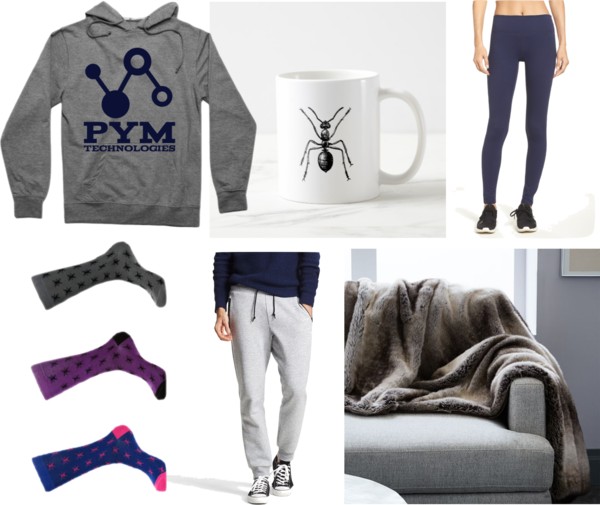
    Zella leggings give you quality and comfort. They work hard (like ants, and unlike me today), so they don’t lose their shape and the color doesn’t easily fade — key to keeping lounge-wear colony-cool. These have a small pocket in the waistband, so if you decide to be a bit more antdustrious and, say, go for a run later, they’re also convenient (no one likes to hold on to their keys). But if leggings aren’t your thing, Uniqlo joggers are a laissez-fashion win (though in cooler weather, the more substantial classic sweats from American Giant are a lounging luxury). Whatever your preferred tranquility-time trouser, a Pym Technologies hoodie, ant-print socks, and a faux-fur throw come together to help you relax in colony-cozy couture. Pour a hot cup of Kona coffee in a myrmecological mug, and you’re ready for a laid-back, but stylish, Saturday.

    Lazy S-ant-urday


    Hooded pullover
    teepublic.com

    Zella clothing
    nordstrom.com

    Drinkware
    zazzle.com
  • The Daily Ant hosts a weekly series, Philosophy Phridays, in which real philosophers share their thoughts at the intersection of ants and philosophy. This is the eighteenth contribution in the series, submitted by Dr. Curtis Franks.


    Towards a ‘Pataphysics of Anthills

    A quick Google search of the noun-phrase “Ant Hill” turns up fifty-three million articles about Clarence Thomas and almost nothing about ant hills themselves. A more conscientious search, especially one that does not utilize the autocomplete device provided by most modern webreaders, returns only about a tenth as many articles, but more than half of them are about ant hills. This single observation should suffice to underscore the importance of methodological piety in all inquiries about ants and their hills. One must be clear up front: What are our questions? What methods shall we use to answer them? What are the limits of reasonable precision for this type of investigation, and how can we most efficiently surpass them?

    Anthill
    An anthill. Or is it? Photo: Alex Wild

    (more…)

  • Antrepid reader Megan Mitchell recently sent us the following note:

    Ant facts featured on this week’s (episode 169) “No Such Thing as a Fish” podcast! Relevant bit starts at 27:36. [Link]

    At first, as we began to listen, we were excited. The story begins with a nice quote about giant ants in India, from the 3rd century B.C.E. Thus, the vertebrate podcast members draw listeners in unawares, deceiving them into thinking they are enjoying a pleasingly pro-ant audio bit. But then… the Vertebrate Agenda is unmasked – these “ants” are really marmots! The hosts then rub boric acid into the wound by cheerfully agreeing that “myrmecology” must share an etymological root with “marmot”.

    And the horror doesn’t stop there. Later on, one vertebrate podcast member confidently states that the bullet ant, Paraponera clavata, is the largest ant in the world and can “exceed 4 cm”. You don’t need to be Kellyant Conway to recognize this “alternative fact”. Readers of The Daily Ant already know, via our Style Saturdays series, about Dinoponera, which is actually the largest ant in the world. Then later, a different vertebrate podcast member even admits to being “a bit ant racist”.

    In light of these recent developments, we believe it is time for this anti-invert podcast to change it’s name to “No Such Thing As A Fact”.

  • Style Saturday: Creepy, Crawly, and Golden

    Editor’s Note: The Daily Ant hosts a weekly ant fashion series, Style Saturdays. This eleventh installment is by our Fashion Correspondant Kathryn Pogin, who is also an Executive Producer of our popular Philosophy Phridays series. Ms. Pogin is now also an official staff member for this series, so these header attributions will henceforth cease. Enjoy!


    When the Queen’s away, the alates will play! Our beloved Editor-in-Chief is travelling at the moment, so I’m going to take this opportunity to do a late-night post on formicid formal wear. This look marries myrmecological magic with a touch of apiarist awesomeness for a look that’s overall creepy, crawly, and golden.

    If you want a dress that works for a conference presantation but doubles as formal wear, you can’t go wrong with a draped piece from Alexander Wang. Classic, subtle, yet interesting. Thrown on a pair of retro golden Charlotte Olympia sandals, ignore the two-legs-too-many reference on the sole, and focus instead on how beautifully they pair with the Anu bracelet from Alolo’s Genesis collection. Complement your wrist-wear with earrings from the same collection, which pull gold and black together in delicate ant metal-work on polished marble. Store your wallet and phone in an ant-print clutch, or better yet, grab Dolce & Gabbana’s entomologically-embellished phone cover in coordinating tones, too — and you’re ready for a night out with the colony.

    Creepy, crawly, and golden


    Gold handbag
    society6.com

    Dolce Gabbana tech accessory
    $605 – harrods.com

    Anu jewelry
    alolojewellery.com

    Marble jewelry
    alolojewellery.com
  • The Daily Ant hosts a weekly series, Philosophy Phridays, in which real philosophers share their thoughts at the intersection of ants and philosophy. This is the seventeenth contribution in the series, submitted posthumously by the Right Honorable Margaret Cavendish, Duchess of Newcastle.


    [Editor’s note: a〈◊〉symbol indicates missing text]

    Of the Ant

    Mark but the little Ant, how she doth run,
    In what a busie motion 〈◊〉 goeth on:
    As if the ordered all the Worlds Affaires;
    When tis but onely one small Straw shee bearcs.
    But when they find a Flye, which on the ground lyes dead,
    Lord, how they stir; so full is every Head.
    Some with their Feet, and Mouths, draw it along,
    Others their Tailes, and Shoulders thrust it on.
    And if a Stranger Ant comes on that way,
    Shee helpes them strait, nere asketh if shee may
    Nor staies to ask Rewardes, but is well pleas’d:
    Thus paies her selfe with her owne Paines, their Ease.
    They live as the Lacedemonians did,
    All is in Common, nothing is forbid.
    No Private Feast, but altogether meet,
    Whole some, though Plaine, in Publick do they eat.
    They have no Envie, all Ambition’s downe,
    There is no Superiority, or Clowne.
    No Stately Palaces for Pride to dwell,
    Their House is Common, called the 〈◊〉 Hill.
    All help to build, and keep it in repaire,
    No ‘speciall work-men, all Labourers they are.
    No 〈◊〉 keep, no 〈◊〉 they have to sell,
    For what each one doth eat, all welcome is, and well.
    No Jealousie, each takes his Neighbours Wife,
    Without Offence, which never breedeth 〈◊〉.
    Nor fight they Duels, nor do give the Lye,
    Their greatest Honour is to live, not dye.
    For they, to keep in life, through Dangers run,
    To get Provisions in ‘gainst Winter comes.
    But many loose their Life, as Chance doth fall,
    None is perpetuall, Death devoures all.


    MargbigRight Honorable Margaret Cavendish, Duchess of Newcastle is a 17th-century English philosopher also known for her poetry, science fiction writing, and scientific work. For more on the Duchess, check out her academic website.