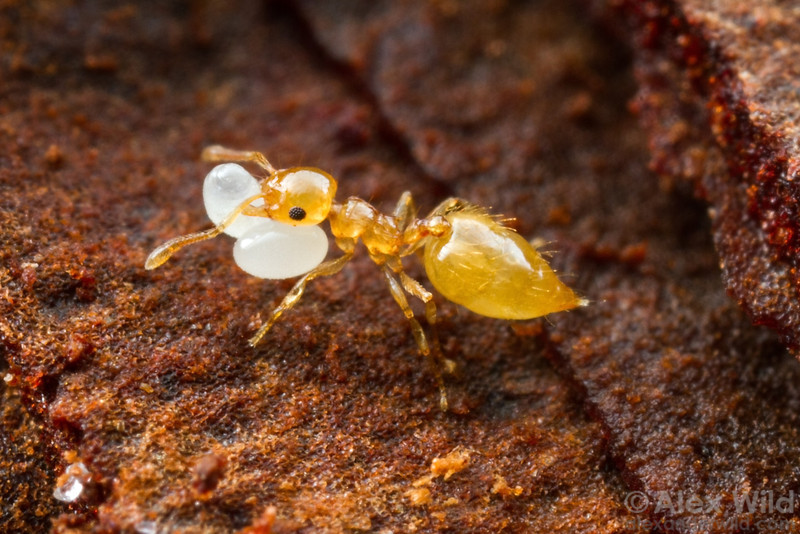
• Søren Kierkegaard was indeed sore sometimes! Mincing no words in his journal, Kierkegaard reached for an ant metaphor to critique what he perceived as the mediocrity of contemporary Christendom:

    “Consider first Peter the apostle. He is an apostle and therefore measures a good two feet taller than what we call the mediocre… listen, you battalions of mediocrity, you who are ants compared to Peter and yet are duped by the preachers to thinking that you are Christians and that by this kind of Christianity you get to heaven…”

    [From: Søren Kierkegaard’s Journals and Papers, vol. 3, p. 2685, ed. and trans. by Howard V. Hong and Edna H. Hong]

    Luckily for the “battalions of mediocrity”, one could easily do more than a mite worse than an ant.

    A luscious-lipped philosopher.

  • Fans of K-Pop will recognize this group of young men as the world-famous South Korean band “BTS”:

    Image credit: Cindy Ord/WireImage

    Fans of ants will wonder what BTS has to do with ants.

    It turns out that the boy band’s music label is Big Hit Entertainment, which is going public in a much-anticipated IPO next month. As explained in a Japan Today article published on Saturday, the South Korean investor market is flush with cash as a result of government intervention amid the COVID-19 pandemic. The army of retail investors that emerged to spend this cash are known locally as “Ants”!

    The Japan Today article reports that some (presumably wealthy) BTS fans are looking to compete with the Ants for shares in the newly public company, in order to add to their BTS “memorabilia”. If these Ants are anything like their counterparts in nature, the BTS fans are sure to have their work cut out for them.

  • We really shouldn’t be surprised. Is it even possible that a company with a vertebrate mascot – namely, a gecko – could resist eventually succumbing to myrmecophobia? After all, some geckos eat ants! Whether or not we could have avoided such a fate, witness (if you can stomach it) this Geico advertisement, released early last month, that is predicated on the antiquated concept of an ant “infestation”:

  • Marvel at the iridescent coloration of this ant, Rhytidoponera aspersa:

    Image: Alex Wild

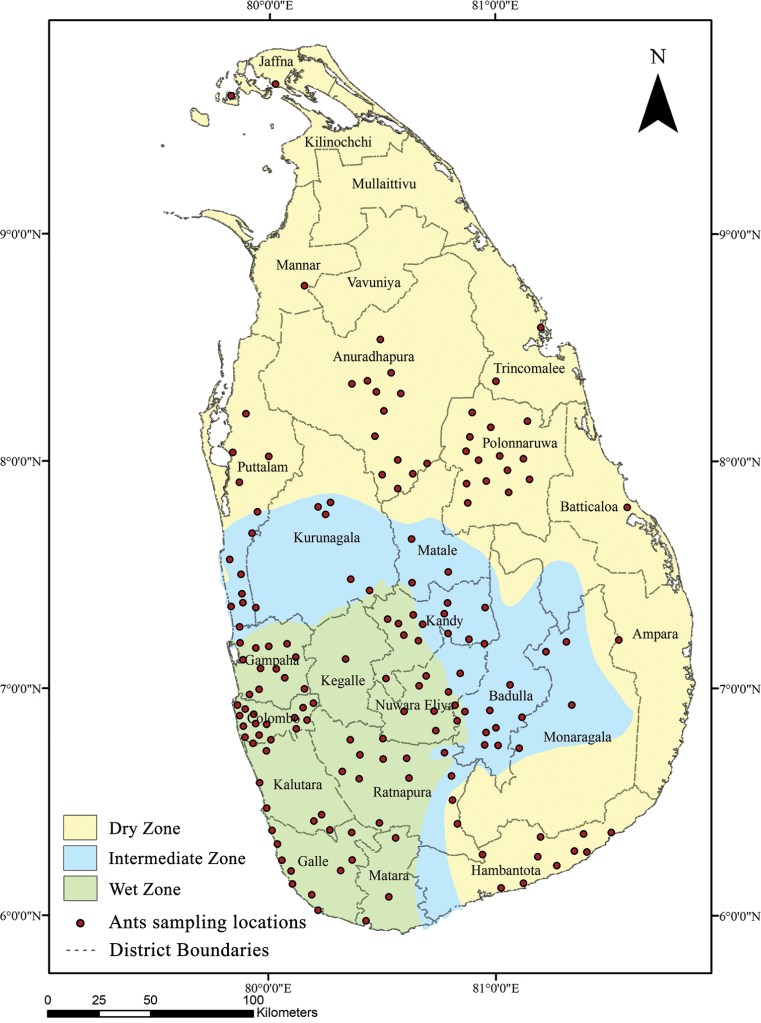
  • Some of the most important and critical myrmecological research is the “simple” identification and documentation of what ant species are present in a given region. Such work is in fact quite difficult and time consuming, and the incentive structures of modern academic science typically severely undervalue necessary taxonomic efforts. Thus, much of the world lacks even a robust, modern checklist of present species. Thanks to a study published this month in ZooKeys, the island nation of Sri Lanka is no longer one such region!

    Figure 2 in Dias et al. (2020), depicting ant sampling localities.

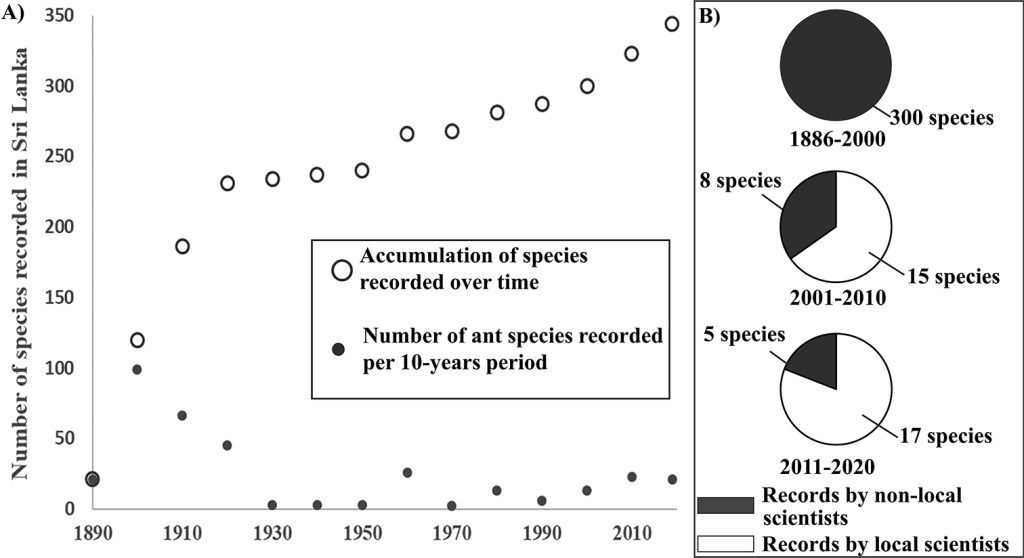
    Authors Dr. Ratnayake Kaluarachchige Sriyani Dias and colleagues produced the most comprehensive checklist of the ants of Sri Lanka to date, largely relying on data from previous studies as well as available museum records. Their checklist includes 341 species on the island that is about the size of the U.S. State of West Virginia (the latter of which is home to a paltry 55 native species). The authors highlight that much taxonomic work remains to be done, as many of the species recorded on the island date back to over 100 years ago, “at a time when species descriptions were sometimes incomplete or species boundaries poorly defined.” Dias and colleagues also note that local scientists drive the recent increases in exploration of the Sri Lankan ant fauna.

    Figure 1 in Dias et al. (2020). A: Rate of species recording in Sri Lanka per decade from 1886 to 2020. B: Number of species recorded in Sri Lanka per period in function of the origins of the authors contributing to these discoveries

    Virtually all research in ecology and evolutionary biology relies on robust taxonomic research, and so we applaud this contribution to ant taxonomy!

  • Readers with a mind like a steel trap jaw ant’s mandibles will remember that Poorly Drawn Lines is, without a doubt, the comic strip of record when it comes to formicid-friendly comics. Don’t believe us? Click here, here, here, here, and, if you dare, here.

    Well, ants have six legs and so it’s only natural that PDL would produce ant comic #6. Enjoy the aptly-titled “Ants Again“:

    Many thanks to our dedicated Comic Correspondant Matt Hernandez for bringing this comic to our attention.

  • It is only natural that our favorite social insects made it into the U.S. television show Community. Thanks to our Tube Correspondant Katerina Pollard – always on the ant T.V. beat – we know that in this case, what is natural is also real. Enjoy this short clip, captured by Correspondant Pollard, from Season 2, Episode 19 (“Critical Film Studies”):

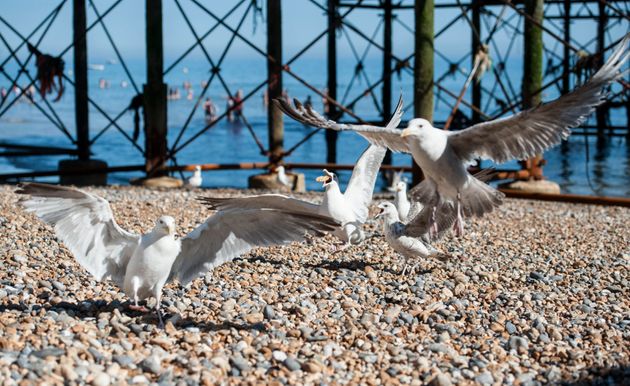
  • According to a 2016 report in The Huffington Post, when winged ants (males and reproductive females) emerge for their nuptial flights, the seagulls go wild. Or, rather, they trip out on the ants’ formic acid.

    Image: Lauren Hurley/PA Wire

    As reported in HuffPo:

    “Dr. Rebecca Nesbit of the Society of Biology says the ants contain formic acid, which can cause gulls to appear “drunk” and lose their inhibitions after eating them.”

    The real story here is that the seagulls ought to learn their lesson. Humans, too, ought to read this story and realize that ants, while often delicious, should, as a rule, be seen but not eaten. Of course the vertebrate media has its own agenda, and thus the HuffPo headline reads “Seagulls ‘Drunk’ From Eating Flying Ants May Pose A Danger To Humans”. Well, they may huff and they may puff, yet no human media outlet will deceive diligant readers into believing that ants are the problem here.

    We appreciate Worker Correpondant Jason Bates sending us this article!

  • The scientific journal Asian Myrmecology recently announced a delightful and creative new logo. Take a look:

    The logo was designed by the artistically antspired Runxi Wang (王润玺/王潤璽), a PhD candidate at Hong Kong University. See here for other design work by Mr. Wang.

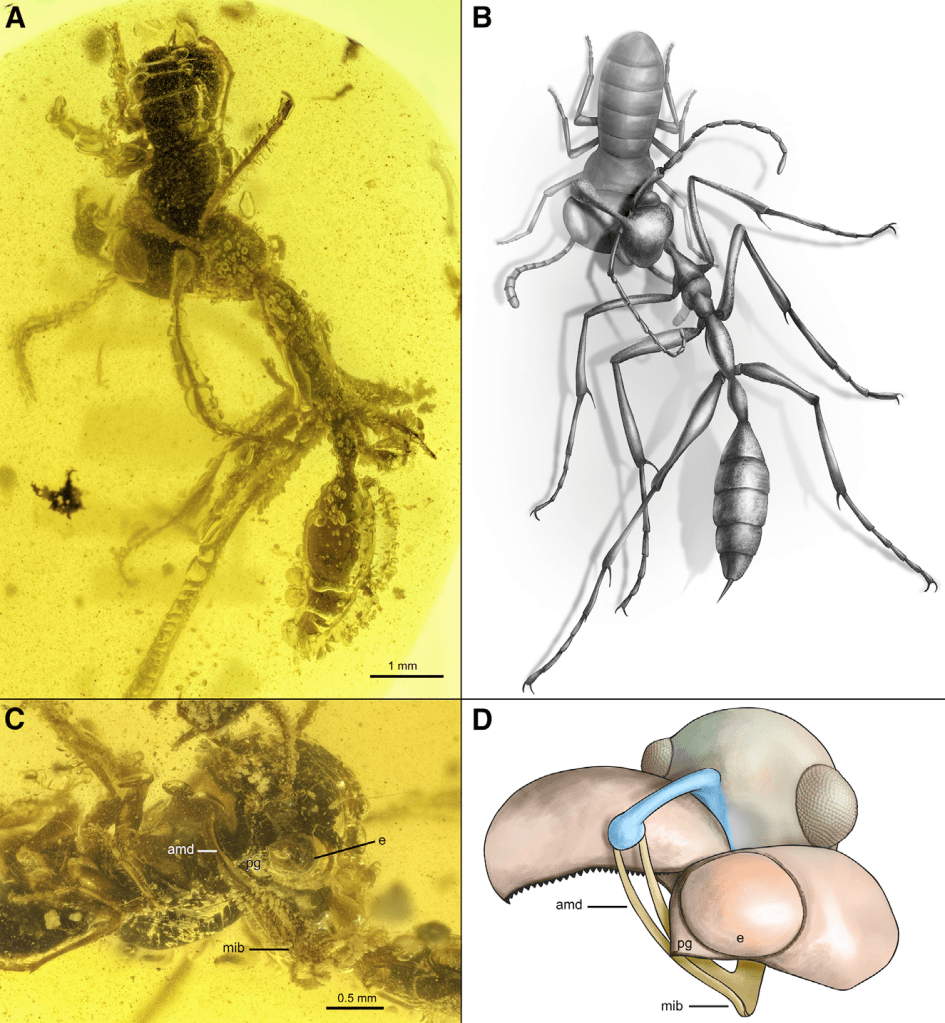
  • The year is 98787980 B.C.E. You gaze upon the reflection looking back at you from a tiny puddle in the soil. It’s a Caputoraptor elegans nymph! You are a Caputoraptor elegans nymph. While scurrying around to find some food, you idly ponder the relatively pleasant and carefree nature of your existence. Mere seconds after you complete this thought… BAM! You are trapped within the jaws of a monster that you didn’t see coming. Before your senses vanish forever, you marvel at the bizarre biological contraption that has ensnared you. Long jaws grab under your body, pressing you against remarkable horns protruding from the head of your captor. You feel no shame at finding yourself captured. How could you possibly have anticipated a predator that is so… weird? All goes dark. You know no more.

    The year is 98787980 B.C.E. You catch a glimpse of yourself reflected against a wet, waxy leaf. It’s a HELL ANT! You are a hell ant. But that doesn’t matter much to you right now, as all you can mentally process is the intensity of your desire to find food. The larvae at home depend upon a successful capture. Ah – what is this passing by? A Caputoraptor elegans nymph! Delicious. He looks rather distracted, to be honest. Almost lost in thought. Should be an easy grab. Discretely approaching with your jaws open wide, hanging down from the bottom of your head, you get just close enough to the delicious, juicy critter, which strikes your sensory setae… BAM! Your jaws slam shut, moving upwards faster than even you yourself can process, trapping the little nymph, whose remaining seconds of life are rapidly drawing to a close. Turning to the left and walking a bit in the direction of your colony, you feel triumphant and, frankly, superior. Is there any insect that can escape the lightning speed of your trap jaws? Proud and haughty, you traverse a recently fallen tree trunk, step in some gooey, oozy resin, and discover that you are unable to move. Slowly sinking into the viscous liquid, you feel some shame at finding yourself captured by a dying tree. All goes dark. You know no more.

    The year is 2020 C.E. You finish brushing your teeth, and see Dr. Phil Barden in the bathroom mirror. You are Dr. Phil Barden! You drive to work, a bit annoyed at the traffic between your home and the New Jersey Institute of Technology. This ephemeral annoyance soon gives way to wonder, as you sit down to examine a new pair of specimens preserved in 100-million-year-old amber. You have discovered the first documented, fossilized instance of predation by Haidomyrmecine “hell ants”. Such behavior, frozen in time, confirms the previously proposed, unusual mechanism of prey capture utilized by this extinct group of ants. You now have solid proof that, unlike all extant ants, these extinct hell ants moved their mandibles in a vertical rather than horizontal direction… BAM! You have written up a manuscript describing your remarkable findings, with two co-authors, and proudly submit the manuscript to Current Biology.

    Figure 3 in Barden et al. (2020)


    Update [September 18th, 2020, 8:40am]: The real-life Dr. Phil Barden provides some details surrounding the actual location of the specimen, and where he was when he analyzed it:

    We apologize for any confusion arising from our imaginative retelling of this interesting study!

  • Blessed readers, we are pleased to announce two items of interest to you, the antlightened crowd!

    i-Fkccf5B-L
    A reminder of ant beauty, for those who have forgotten. Image: Alex Wild

    First, after too long of a publishing hiatus brought on by an unfortunate combination of distraction and malaise, it is our intention to resume the regular production of premier ant content for general consumption within the next week or so.

    Second, The Daily Ant, our very own media outlet, was featured on the first page of the 25th issue of Current Affairs, a wildly popular leftist magazine that we recently favorably covered for expressing proper ant empathy. Check it out below!

    https://twitter.com/BenDBlanchard/status/1294017289466118146

  • [This article has been updated with a response from Lyta Gold.]

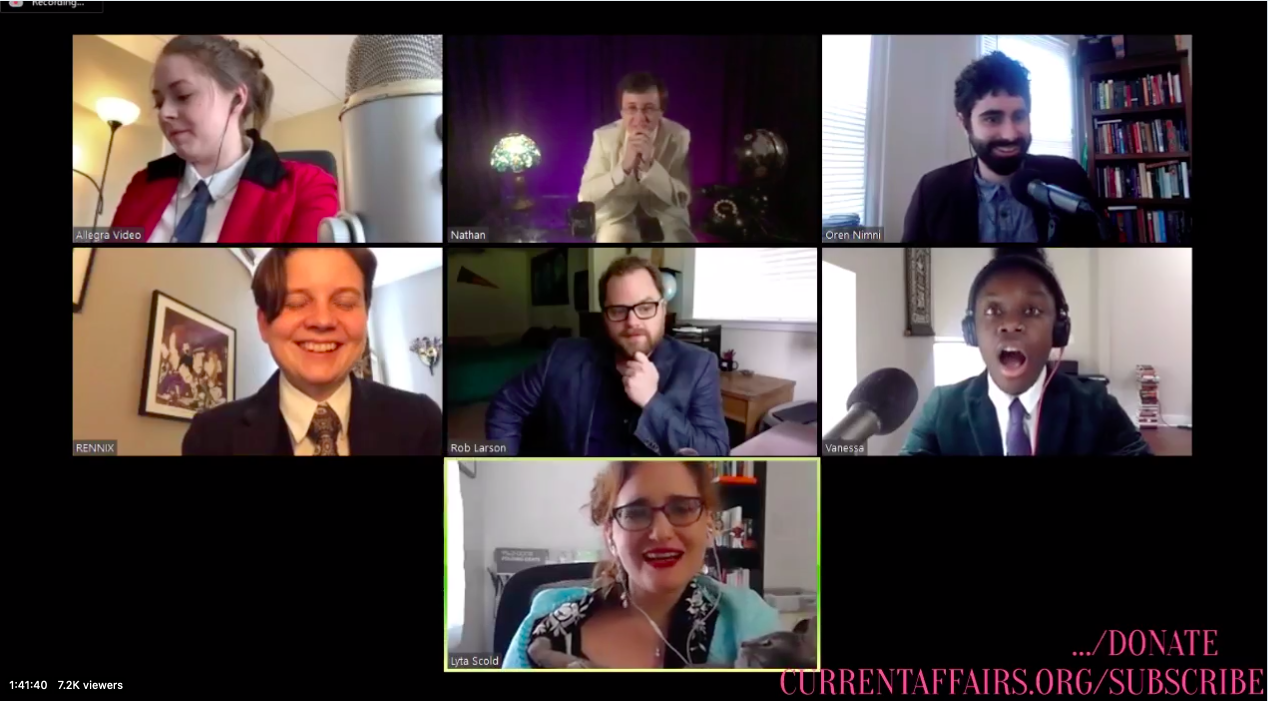
    Just a few weeks ago, we penned an editorial taking alleged leftists Katie Halper and Matt Taibbi to task for the egregiously anti-ant content on their podcast. Today, we have much more uplifting news to share: A genuine leftist outlet, Current Affairs, hosted a live stream discussion among their editorial and writing staff, and chose to open their chat with an exciting story about ants! Unlike the charlantans Halper and Taibbi, the Current Affairs crew prove their myrmeco-friendly bona fides with an exemplary display of ant empathy.
    Screen Shot 2020-05-04 at 8.20.09 AM

    The live stream begins mid-conversation, with Lyta Gold telling the tale:

    Lyta Gold: “… through, and his little society, anyways, he and his girlfriend got into a fight. Didn’t seem like it was about anything particularly serious. She SMASHED his fire ant colony —“

    Oren Nimni: “What? That seems super dangerous…”

    LG: “So the ants went into the wall, and just like, through the other apartments in the building. And they, like, sting and it’s extremely painful. And these were his pets, he loved them, he’d taken really good care of them for years, and [inaudible]. And she just got so mad at him she smashed it, and now they’re everywhere and he’s like, ‘I need to break up with her, but it’s quarantine. And the fire ants are everywhere.’ And I’m like, that’s the worst situation, I actually can imagine it.”

    Vanessa Bee: “He’s got spicy tastes in pets and women, and sometimes…”

    Brianna Rennix: “It reminds me of that part, you know in Little Women, where like Jo’s little sister burns her script? You never come back from that, right?”

    ON: “That was a huge overreaction.”

    VB: “If someone burnt my manuscript, and we still lived in a paper world? It’s their only copy!”

    BR: “He never speaks to that person again. They wouldn’t be likely to live.”

    With the exception of Oren Nimni, who requires some thoughtful self-reflection, these true leftist writers show how, even with a recognition that ant stings are painful to humans, ants deserve love and care. We applaud Current Affairs for promoting a more formicid future. To subscribe to this noble and progressive media outlet, go here. To donate to a rare, ant-friendly human news source, go here.

    See here for the full video (the ant tale begins mid-story right at 00:00):

    https://twitter.com/curaffairs/status/1257037543838605313


    UPDATE [May 4th, 10:22am]: Lyta Gold has weighed in with her response to our article. Needless to say, she has remained consistant with her principles:

    https://twitter.com/lyta_gold/status/1257324755947892740

    She also shared a link from Reddit that details the full story! Check it out here.