The Daily Ant hosts a weekly series, Philosophy Phridays, in which real philosophers share their thoughts at the intersection of ants and philosophy. This is the sixth contribution in the series, submitted by Keshav Singh.
Do ants do things for reasons?
Ants are creatures that seem to do a lot of things. When you see an ant, it is likely either scurrying around in the midst of some task, or dead. One question we might ask when we see an ant doing something is: why is the ant doing that?
However, it is often not clear to the average observer exactly what task an ant is in the midst of; without knowing what an ant is doing, we clearly can’t explain why it is doing that. On the other hand, myrmecologists spend their lives figuring out what ants are doing and can offer plenty of explanations of why they do what they do.
Myrmecologist Bonnie Blaimer collecting ants. Photo: Alex Wild
So, you have some communities of ants. You notice that some communities are more diverse than others. In one community, certain species of ants are more common, while in another, different species are more common. How can you explain this coexistence and variation? Dominance hierarchies, perhaps?
Dominance hierarchies have played a key role in ant ecology for many years. These hierarchies describe the relative ability of each species in a community to dominate over others, and tend to be constructed as a single, linear list. In other words, Species A is dominant over Species B which is dominant over Species C which is dominant over blah blah blah. Such a dominance structure is thought to impact species coexistence and variation in community composition across different habitats.
But wait! A recent review and discussion by Dr. Katie Stuble and colleagues challenges this paradigm of dominance hierarchies, suggesting that myrmecologists must improve and move beyond the use of such hierarchies to better explain the processes that structure ant communities. The researchers argue that the most common metrics employed to assess dominance (based on factors ranging from one-on-one aggression to control of food baits) differ in their ecological implications and, critically, are inconsistent in their findings when used on identical sets of data. Furthermore, the concept of a strict dominance hierarchy is unlikely to adequately describe the dynamic and complex nature of real ecological communities. They also offer some suggestions for enhancing future work, including explicitly defining “dominance” and incorporating network theory in studies of dominance, as well as abandoning any uniform application of dominance hierarchies altogether. Check out the paper for more!
The Daily Ant hosts a weekly series, Philosophy Phridays, in which real philosophers share their thoughts at the intersection of ants and philosophy. This is the fifth contribution in the series, submitted by Dr. Barry Lam.
Hi-Phi Nation, a new and exciting philosophy podcast, produced this intriguing audio bit for The Daily Ant. It is about 5 minutes long. Enjoy!
Production Credits
The story of Jacob Lomanski is adapted from an episode of the Here Be Monsters podcast produced by Jeff Emtman and Bethany Denton.
Soundtrack:
“Nothing Lasts Forever”, “Intro”, and “Fairytale” by Kai Engel
“Waves” and “Labyrinth” by Sergey Cheremisinov
Dr. Barry Lam is the host and producer of the new story and sound-driven philosophy podcast, Hi-Phi Nation. The ten episode first season is airing now online or on any podcatcher you use. Each week on the show, the podcast starts with a story, and then brings the philosophy out of the story. Barry is a Associate Professor of Philosophy at Vassar College, and Humanities-Writ Large fellow at Duke University.
Brooklyn’s most ant-friendly craft brewer, Dailey Crafton, sat down with The Daily Ant to discuss beer, ants, and… well basically just beer and ants. Enjoy!
Our editor-in-chief was recently interviewed over at Coffee Beings And Things. He was asked about coffee, ants, and more! But mostly ants. Check it out.
Here at The Daily Ant, we generally support the little gal. Yet we can’t help but appreciate a particular financial services group:
Ant Financial Services Group hails from China, and according to the Wall Street Journal, it is (unsurprisingly) a “juggernaut of online banking, fund management and other financial services.” Sounds like they chose the right name!
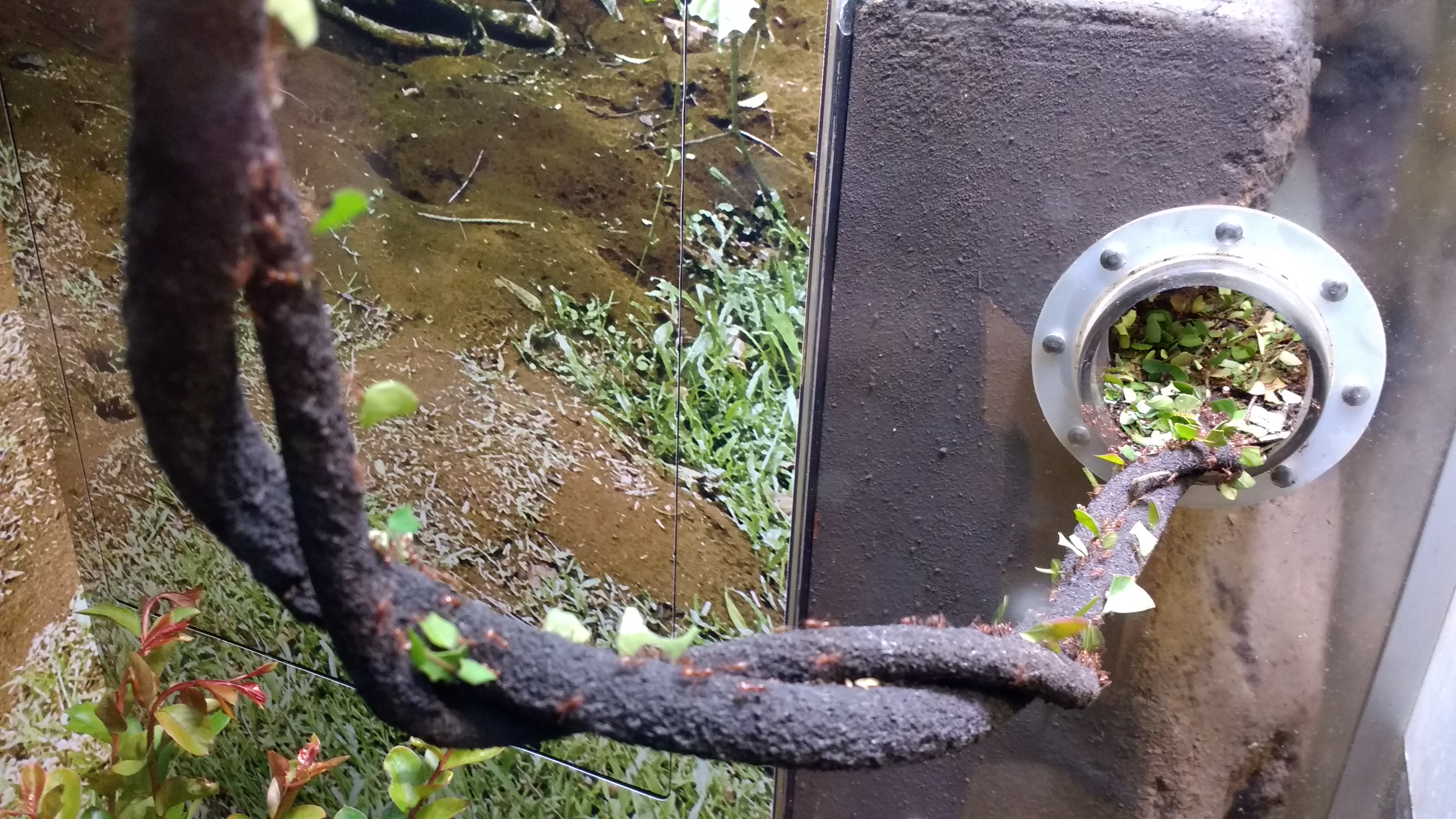
This is, of course, a colony of Atta cephalotes, one of several species of leaf cutter ants. Correspondant Bhattacharyya also shared the following:
One man who worked at the museum came up since we were spending a while beside the leaf cutter ants, and told us he even recently saw one of these in the swamps here, and he showed us a picture of one on his finger.
Based on known distributions of species in the genus Atta, it is much more likely that this fellow saw a related species, Atta texana. In any case, this is exactly what an effective museum should do – motivate visitors to remember and dwell upon previous experiences with the natural world, and then promote further discovery.
Forget Mardi Gras and jazz – visit New Orleans for its insect museum!
The Daily Ant hosts a weekly series, Philosophy Phridays, in which real philosophers share their thoughts at the intersection of ants and philosophy. This is the fourth contribution in the series, submitted by Cheryl Abbate.
Consider the Ant
Many people object to raising and killing animals like cows, chickens, and pigs for food because they are conscious (i.e., sentient). Farmed animals clearly have interests, such as the interests in not suffering and continued existence, and there is “something it is like” to be a cow, pig, or chicken. But what about insects, like ants? Are they conscious? Is there “something it is like” to be an ant? If not, perhaps we ought to consume insects, like ants, in lieu of factory farmed animals.
Anyone who is a human living in a human society knows that social life carries with it the risk of catching a disease from other nearby humans. Of course, this is also the case for ants in their societies. But a fascinating paper in Ecology and Evolution has recently revealed another commonality: some wood ants, like humans, create antimicrobial drugs. To learn more, check out this nice discussion in Science.
Fomica wood ants, cluelessly spreading harmful bacteria? Photo: Alex Wild
Developmental stages of Oecophylla smaragdina. Photo: Alex Wild
The researchers hypothesized that a socially simple species, Formica subserica, would exhibit more “neuroplasticity” (flexibility in brain development) than a more socially complex species, Oecophylla smaragdina, which has behaviorally and morphologically distinct worker castes. Dr. Kamhi and colleagues expected that O. smaragdina would have more rigidly determined brain structure due to the maintenance of task specialization in workers that seem less behaviorally flexible than more generalized F. subserica workers. So, they looked at ant brains! In particular, they compared the volume of brain regions that have different functions, and assessed the impact of visual experiences on regions associated with “higher-order sensory integration”.
Do you think the researchers confirmed their hypothesis? If you do, you are wrong! Surprisingly, neither species exhibited differences in brain changes due to visual experiences, and O. smaragdina – not F. subserica – exhibited greater levels of neuroplasticity as workers aged. These results suggest that social complexity, despite associated task specialization, may drive increases in neuroplasticity. It is possible that this increase is necessary to maintain higher levels of coordination and communication seen in complex ant colonies.
The Daily Ant hosts a weekly series, Philosophy Phridays, in which real philosophers share their thoughts at the intersection of ants and philosophy. This interview with Dr. Ram Neta is the third contribution in the series.
On Tuesday, Dr. Ram Neta sat down with The Daily Ant to discuss ants, rationality, and more – Enjoy!
Dr. Ram Neta is an Associate Professor of Philosophy at the University of North Carolina at Chapel Hill. He specializes in epistemology and rationality, and has published many manuscripts on these subjects. For another YouTube video featuring Dr. Neta and rationality, click here.






 Dr. Ram Neta
 The Daily Ant