• The Daily Ant maintains “Formicid Form”, a Sunday ant poetry series. When possible, our Verse Correspondant, Natalia Piland, provides a short commentary at the end of each poem. Enjoy!


    Poem in Haiku Poetry (1968)

    By J.W. Hackett

    The ants on this cloth

    are even carrying off

    their own casualties.

    (more…)

  • A peaceful picture for those of you still awake approaching midnight on this calm Saturday night.

    (more…)

  • The Daily Ant hosts a weekly series, Philosophy Phridays, in which real philosophers share their thoughts at the intersection of ants and philosophy. This is the fifty-sixth contribution in the series, submitted by Dr. Audrey Yap.


    Speech Acts and Unspeakable Ants

    At the annual ACP/CPA (Association Canadienne de Philosophie/Canadian Philosophical Association) conference, I encountered an ant-related speech act.

    (more…)

  • The time is upon us. Ant-Man and The Wasp debuts early in theaters all around the United States today. This day. Thursday, July 5th, 2018. Prime yourself by watching both trailers for the film, and then do your civic duty. Get out to the box office and put your money where your mandibles are! Let us invert the Hollywood agenda together.

  • The great Swiss myrmecologist Auguste Forel (1848 – 1931) once observed that “the greatest enemies of ants are other ants, just as the greatest enemies of men are other men.” In general, this maxim appears true – with exceptions. Once such exception was reported in 1977 in the journal Nature, by myrmecologists James H. Brown and Diane W. Davidson. These two researchers found that seed-harvesting ants compete with seed-eating rodents (!) in the Silverbell Bajada near Tucson, Arizona.

    (more…)

  • The Netflix show Queer Eye, a reboot of the popular Queer Eye for the Straight Guy, has been met with generally favorable reviews by critics and viewers alike. Thanks to Tube Correspondant Katerina Theodossiou, we now know the reason why, and it’s found in Season 1, Episode 5 (“Camp Rules“). In this episode, the Fab Five give Bobby Camp, a “devoutly Christian father of six”, a makeover. During the all-important scene, Jonathan Van Ness chats with Camp about his morning routine:

    (more…)

  • Cemeteries are known locations of an abundance of human bones. But cemeteries are not the only site where human bones have been deposited, in both modern and ancient times, and investigations of such bones, wherever they are found, can often tell us a lot about traumatic injuries, environmental changes, cultural histories, and a number of other phenomenon that might interest anthropologists, including forensic anthropologists. However, interpreting bones can be difficult. Various destructive factors can change the shape and other features of bones over time, and thus the more we know about processes of bone destruction, the more we can know about the other phenomena associated with the bones.

    And here’s where the ants come in. A paper published earlier this year, in Forensic Entomology, formally reports a discovery that previously had only been the subject of speculation and anecdotes: direct modification of human bones… by ants.

    (more…)

  • The Daily Ant maintains “Formicid Form”, a Sunday ant poetry series. When possible, our Verse Correspondant, Natalia Piland, provides a short commentary at the end of each poem. Enjoy!


    El Hormiguero (2010)

    Song by Calle 13, English translation here

    The ants have arrived here,
    We are conquering enemy territories,
    Invisible, silent, and simultaneous,
    The entire invasion is subterraneous.

    (more…)

  • The Daily Ant hosts a weekly series, Philosophy Phridays, in which real philosophers share their thoughts at the intersection of ants and philosophy. This is the fifty-fifth contribution in the series, submitted by Dr. Danny Weltman.


    Personal Identity and Personal Idantity

    In the movie Antz, the worker ant Z-4195 regards hundreds of ants all dully dancing in the same shuffling motion and moans “why does everybody have to dance the same way? It’s completely boring. It’s monotonous.” In the ant colony depicted in the movie, all the worker ants are more or less the same, which is why they only get numbers for names. But, of course, all the workers are different from each other, too. They each have their own number, at least. If they’re all basically the same, what makes them different from each other?

    (more…)

  • There is an African ant species of tiny workers that lives in big trees. In these big trees, the little ants scurry around long, narrow cavities in the bark, tending to the even littler insects they harvest as livestock. Outside of these big trees, the little ants can barely stand.
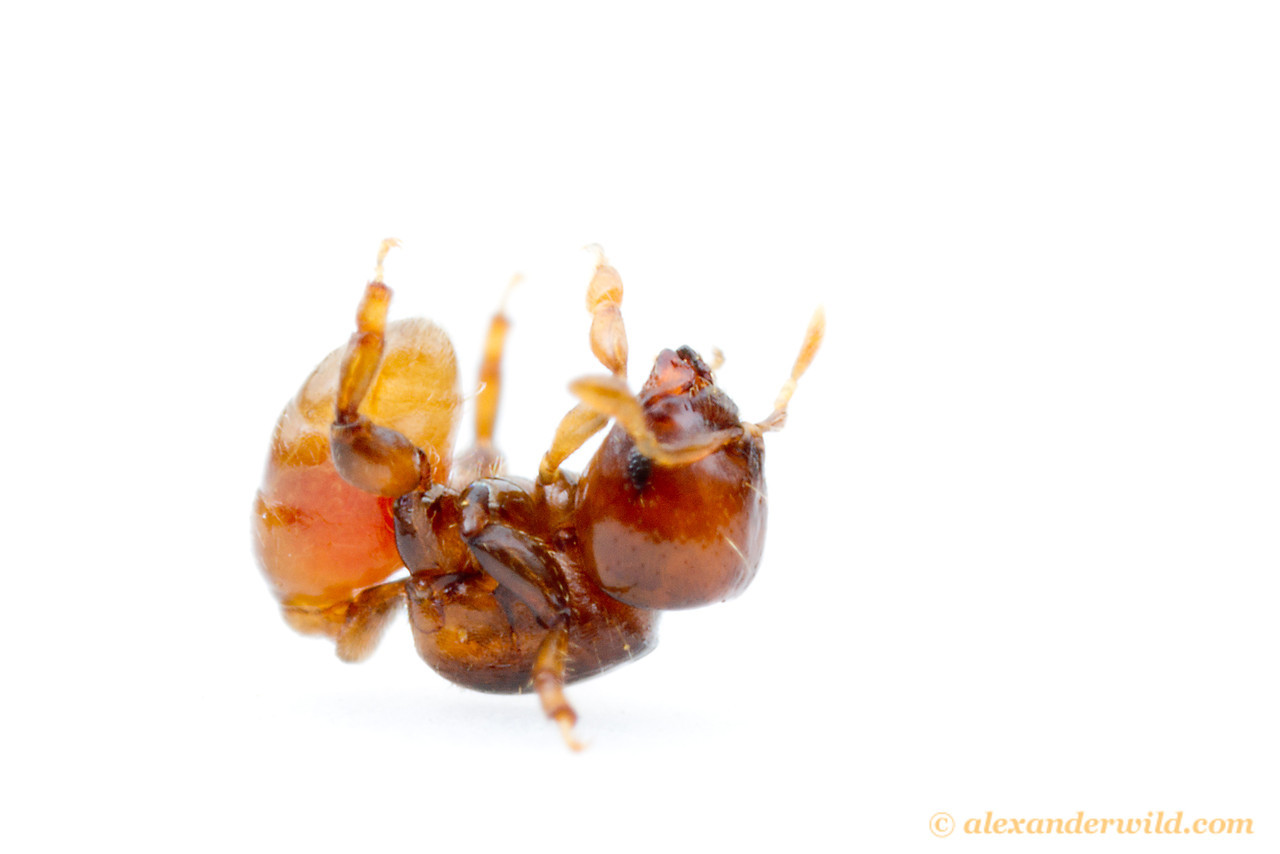
    weissi3-X2

    The difficulty that the gals have in standing up straight is owing to the unusual, upturned shape of their mid-coxa, the first segment of their middle legs. This morphology forces their middle legs into an upturned position, increasing grip in the bark tunnels they inhabit but hindering movement when outside the tunnels. Furthermore, as AntBlog Myrmecos noted in 2012, Melissotarsus ants may be the only non-humans known to farm animals for meat, and the adult workers spin silk!

    Melissotarsus may have a mere four species to its name, but they’re four wacky species indeed.

  • What do you do if you’re a huge singer-songwriter and also named Paul Simon? You join forces with mega-myrmecologist E.O. Wilson to promote biodiversity and conservation. Enjoy this (shaky) video, where Simon talks about Wilson’s global biodiversity initiative, the Half-Earth Project, while on tour:

  • Committed readers will remember fondly our coverage of Anty Gin, the Beer Ants Gel Habitat, Funky Fresh ant beer brewer Dailey Crafton, and an antspired cocktail from Singapore. Well, we have another exciting libation to share with you!

    Our editor-in-chief is currently in southern China for an investigative journalism project on Polyrhachis spiny ants. But he also recently found a treasure: 黑蚂蚁养生酒.

    (more…)